

 Offline/Online Class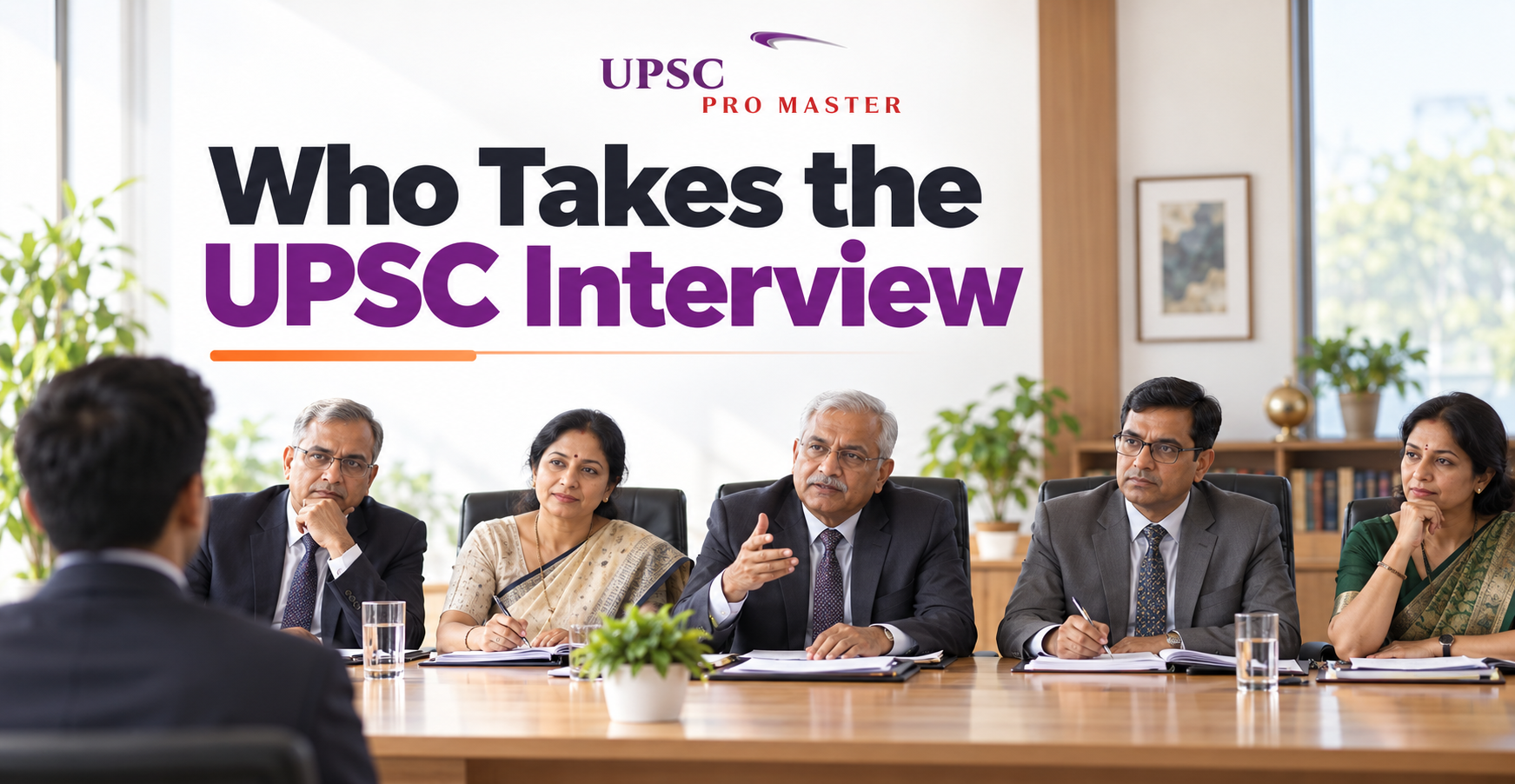
Who takes the UPSC Interview? A board constituted by the Union Public Service Commission conducts it. Officially called the Interview/Personality Test, it is the final stage of the Civil Services Examination—not an oral version of Mains. The panel evaluates whether a candidate’s judgment, integrity, awareness and thinking suit public service.
It carries 275 marks in the 2,025-mark merit total. Usually lasting less than half an hour, it can materially change a candidate’s rank and available service. Here is how the panel, venue, process and marks work.
What Is the UPSC Interview and Who Conducts It?
The Union Public Service Commission, a constitutional body under Article 315, conducts the Personality Test after the written Mains result. Candidates meeting the written-stage standard are summoned.
The UPSC Civil Services Examination 2026 notification says a board of “competent and unbiased observers” interviews candidates with their career record before it. The purpose is personal suitability for the services. UPSC calls it a “natural, though directed and purposive conversation,” not a strict cross-examination.
|
UPSC Interview detail |
Verified position |
|
Official name |
Interview/Personality Test |
|
Conducting authority |
Union Public Service Commission |
|
Maximum marks |
275 |
|
Separate qualifying marks |
None prescribed |
|
Merit calculation |
Mains written 1,750 + Interview 275 = 2,025 |
|
Usual duration |
About 20–30 minutes; no fixed official limit |
|
Venue |
Dholpur House, Shahjahan Road, New Delhi-110069 |
Who Sits on the UPSC Interview Panel?
A government Employment News explainer describes the usual board as five people: one UPSC Member as chair and four external experts. Invitees may come from administration, diplomacy, policing, defence, science, education or other areas of public life, giving the board several perspectives.
The board chair is not necessarily the Chairperson of the UPSC; a Commission Member can chair a board. A professional psychologist does not routinely sit on the panel; Employment News explicitly says otherwise.
Fairness matters more than memorising board biographies. A 2025 Parliamentary reply says candidates are randomly assigned to boards shortly before the day’s tests. Category and written marks are withheld from the board, while interviewer identities are withheld from candidates. (PIB)
UPSC Interview Location: Where Does the UPSC Interview Take Place in Delhi, India?
The Civil Services Personality Test is held at the Union Public Service Commission, Dholpur House, Shahjahan Road, New Delhi-110069. The official CSE 2025 written-result notice confirms this address and states that e-Summon letters are downloaded online; paper summon letters are not issued.
Unlike the Preliminary and Main examinations, the interview is not held at centres across India. The e-Summon letter controls the date, session, reporting instructions and permitted items, so check it before travelling rather than relying on older guidance.
UPSC Interview Time Duration and Daily Sessions
The UPSC interview time duration is commonly 20–30 minutes, although it may be shorter or longer. UPSC prescribes the test’s purpose and marks but not a fixed duration. A short interview is not automatically poor, and a longer one does not prove a higher score.
UPSC normally schedules forenoon and afternoon sessions. Recent schedules used 9:00 AM and 1:00 PM reporting times. These are not guaranteed boardroom entry times; verification and interview order create a wait.
The distinction matters because reporting time covers administration, while interview duration means only the boardroom conversation. Plan the whole half-day, not a 30-minute visit. Carry documents in the order listed, keep breakfast or lunch light, and avoid scheduling a tight return journey immediately after the session at Dholpur House.
What Happens on the UPSC Interview Day?
The exact instructions in the e-Summon letter prevail, but the day usually follows this sequence:
Download the e-Summon letter and recheck the date, session and document list.
Reach Dholpur House early with the letter, original photo identity proof and required original certificates.
Complete security, attendance and document verification as directed by staff.
Receive the day’s board and sequence allocation, then wait in the designated area.
Enter when escorted, greet the board and sit after being invited.
Participate in a conversation that may move from personal background to current issues, judgment and administrative situations.
What Does the UPSC Interview Panel Actually Evaluate?
Questions often grow from the candidate’s record: home district, education, employment, optional subject, achievements and interests. Discussion may connect these with current events, public policy, ethical dilemmas or administrative choices.
UPSC’s stated qualities include mental alertness, critical assimilation, logical expression, balanced judgment, breadth of interests, social cohesion, leadership and intellectual and moral integrity. Honest uncertainty therefore beats bluffing: the board evaluates reasoning and listening, not only factual recall.
Use the DAF–Decision–Delivery framework. First, audit every application claim and its policy connections. Second, practise decisions by identifying stakeholders, rules, trade-offs and a defensible action. Third, answer the question first, give two or three reasons, acknowledge a limitation and stop.
Why Is the UPSC Interview Significant for Final Rank?
The Personality Test contributes 13.58% of the final 2,025 marks and is worth 25 marks more than one 250-mark Mains paper. It has no separate qualifying threshold, but even a moderate score gap can rearrange ranks.
The official CSE 2025 marks list proves the effect. Ishan Bhatnagar scored 823 written and 215 in interview, ranking fifth with 1,038. Surabhi Yadav scored 862 written but 165 in interview, ranking fourteenth with 1,027. The 50-mark interview advantage outweighed a 39-mark written deficit and created an 11-mark overall lead.
Also Read this –
What Actually Happens Before Entering the UPSC Interview Room?
The central lesson is simple: the UPSC Interview rewards a credible public-service personality, not a rehearsed performance. Candidates should know their own record, think in balanced alternatives, communicate directly and treat the board as a serious conversation rather than an adversary.


