

 Offline/Online Class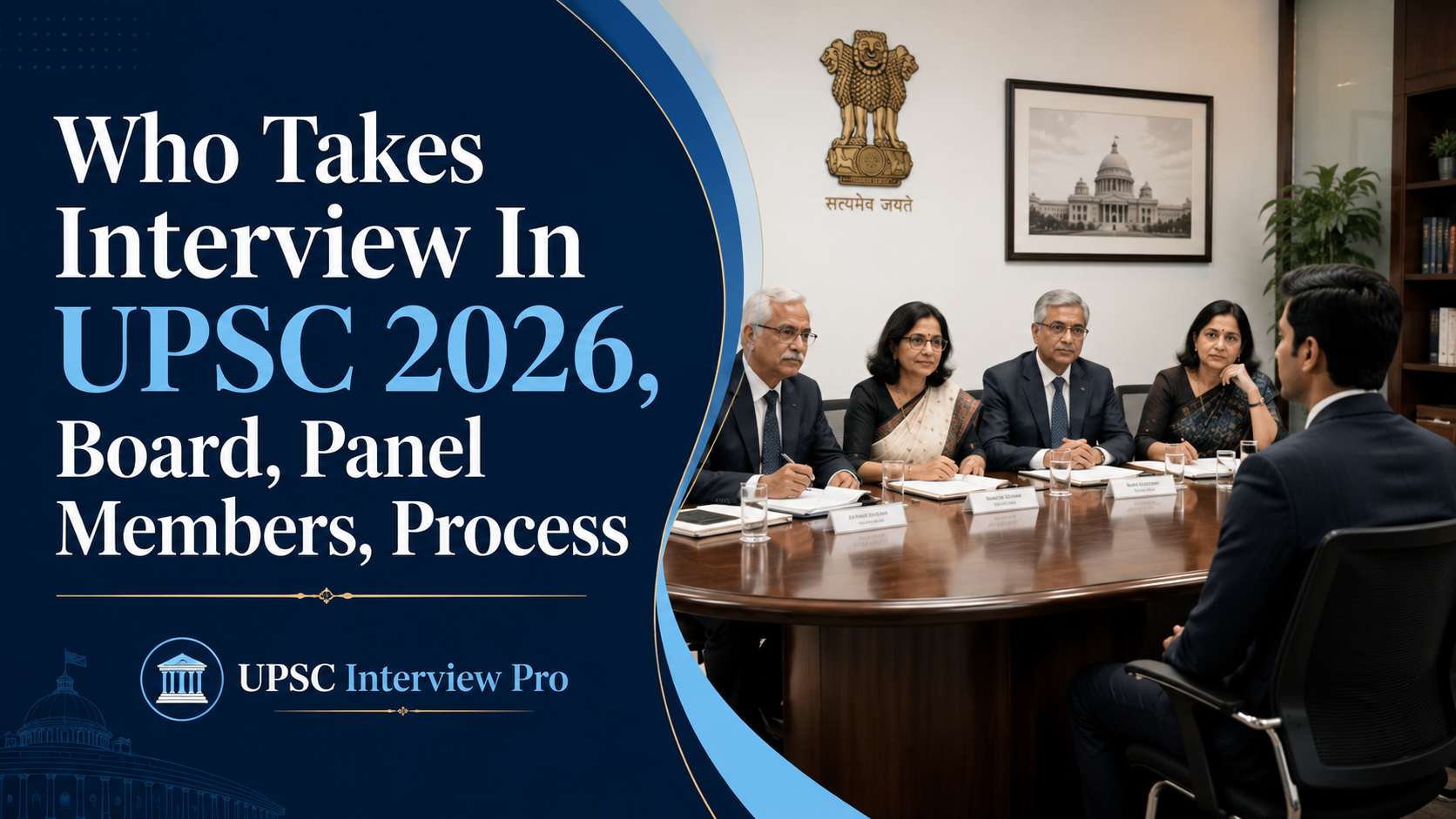
For many aspirants, the UPSC interview is the most uncertain stage of Civil Services Examination. After Prelims and Mains, candidates face a formal conversation where personality, judgement, honesty and administrative suitability matter more than memorized facts. This guide by UPSC Interview Pro explains Interview in UPSC 2026, UPSC interview board, UPSC interview panel, UPSC interview members and UPSC interview process.
What Is the UPSC Interview 2026?
The UPSC interview, officially called the Personality Test, is the final stage of the Civil Services Examination. Only candidates who qualify the Mains written examination are called for it. The interview carries 275 marks, and these marks are added to the Mains written score for final merit.
This stage is not a repeat test of bookish knowledge. The Personality Test assesses mental calibre, balance of judgement, clarity of expression, social awareness, leadership potential and moral integrity required for public service.
Who Takes the Interview in UPSC 2026?
The UPSC interview is conducted by interview boards constituted by the Union Public Service Commission. Each board is headed by a chairperson and includes experienced UPSC interview members from different backgrounds, including civil services, academics, defense, policing, diplomacy and administration.
So, who takes the interview in UPSC can be answered simply: a UPSC interview panel of competent and unbiased observers appointed to assess suitability for civil services.
Composition of the UPSC Interview Board
A typical UPSC interview board generally has one Chairperson and four other members. The Chairperson leads the discussion, sets the tone and may begin with questions from the candidate’s Detailed Application Form, commonly called DAF.
The other UPSC interview panel members ask questions from current affairs, education, optional subject, work experience, hobbies, home state, service preference and administrative situations. The candidate does not choose the board. Panel allocation is handled by UPSC.
What Is the Role of UPSC Interview Members?
The role of UPSC interview members is to evaluate the candidate beyond marks and degrees. They observe how the candidate thinks, listens, responds and handles pressure.
They may test honesty through DAF-based questions, awareness through current affairs, ethics through situational questions and maturity through opinion-based questions on governance, society, technology, economy or international relations.
A good answer is balanced, clear, logical and honest. If a candidate does not know something, accepting it politely is better than bluffing.
UPSC Interview Process
The UPSC interview process begins after the Mains result. Shortlisted candidates receive an e-Summon Letter with date, session and instructions. Candidates must carry original documents and identity proof for verification.
On interview day, candidates report at UPSC headquarters, Dholpur House, New Delhi. After security checking and document verification, they wait for their turn. The interview is formal but conversational and may last 20 to 40 minutes.
Questions are usually based on the DAF, current events, personal background, graduation subject, optional subject, hobbies, home district, state issues and administrative judgement. The board checks whether the candidate has administrative temperament.
Types of Questions Asked in the UPSC Interview
1. Personal Questions
These questions come from the DAF. Examples include: Why civil services? What is special about your district? Why did you choose this hobby?
2. Current Affairs
The board may ask about national and international developments, schemes, social issues, economy, environment, technology, security and India’s foreign policy. Candidates should understand causes, impacts and solutions.
3. Hypothetical and Situational Questions
These questions test decision-making. For example: What will you do if there is communal tension in your district? How will you handle corruption?
4. Opinion-Based Questions
These questions test balance and clarity. The board may ask views on reservation, social media regulation, women’s safety, federalism, AI or climate change. A mature answer recognises both sides and presents a practical conclusion.
What Makes the UPSC Interview Challenging?
The UPSC interview is challenging because there is no fixed syllabus. A candidate may be asked about personal life, local issues, global politics, ethics and administration within one sitting. Body language, tone, listening ability and emotional stability also matter.
Another challenge is unpredictability. Candidates cannot prepare every possible question. Therefore, preparation should focus on self-awareness, analytical thinking and communication. The board is not looking for perfection; it is looking for authenticity and balance.
How to Prepare for the UPSC Interview?
Start with your DAF. Every word written in it can become a question. Prepare your district, state, education, work experience, hobbies and service preference.
Revise current affairs with an interview perspective. Ask: why did it happen, what are its implications, and what should be done? Practise speaking answers aloud and record yourself to check clarity and confidence.
Mock interviews are useful when feedback is taken seriously. UPSC Interview Pro helps aspirants improve answer structure, body language, confidence, current affairs analysis and DAF-based preparation. The aim is not artificial answers, but a sharper, calmer and more presentable personality.
Conclusion
The UPSC interview 2026 will be a test of personality, not just knowledge. It will be conducted by a UPSC interview board consisting of a chairperson and experienced UPSC interview members. The panel will judge clarity, honesty, awareness, judgement and suitability.
For aspirants, the best strategy is simple: know yourself, know your surroundings, stay updated, think like an administrator and answer with honesty. With UPSC Interview Pro, the final stage can become an opportunity to improve your rank before the UPSC interview panel.
Join UPSC Interview Pro for expert mock interviews, DAF analysis, current affairs practice, personal feedback, and focused guidance to face the UPSC panel confidently successfully.


