

 Offline/Online Class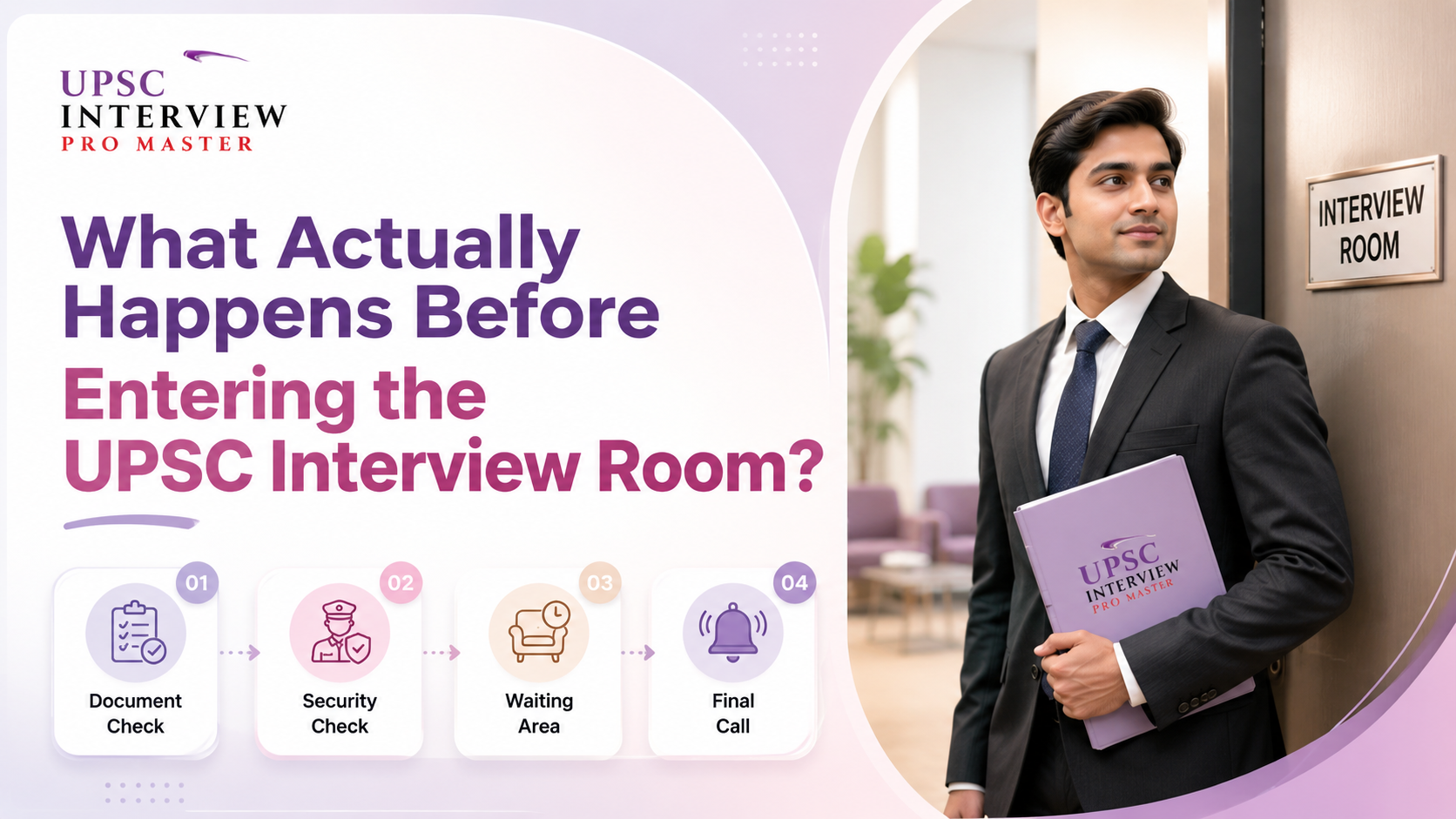
Reaching the Union Public Service Commission building for the Personality Test is a milestone, but the period before entering the interview room is more procedural than expected. You do not walk directly from the gate to the board. First come identity checks, document scrutiny, registration, board allocation and waiting. Knowing this sequence helps you conserve mental energy and enter the UPSC interview with a settled mind.
Process Starts Before Interview Day
After qualifying the Civil Services Main Examination, candidates must complete the online formalities announced by UPSC. These may include updating information, checking personal and educational details, uploading prescribed certificates and downloading the e-Summon Letter. Requirements can change between examination cycles, so the latest UPSC notice and its enclosures must be treated as final.
Confirm the reporting date, session, venue, permitted items and required originals. Arrange the documents a day earlier. A mismatch discovered at home can be handled calmly; the same issue noticed at the venue can disturb your concentration.
Happens Before You Enter the Room
|
Stage |
What Usually Happens |
Best Candidate Response |
|
Arrival |
Entry details are checked |
Reach early and keep the summons accessible |
|
Security |
Identity verification and screening occur |
Carry only permitted items |
|
Registration |
Attendance and details are confirmed |
Follow instructions calmly |
|
Document scrutiny |
Originals and certificates are examined |
Arrange documents logically |
|
Board allocation |
Candidates learn their board or sequence |
Avoid board-related speculation |
|
Waiting period |
Candidates wait for their turn |
Avoid last-minute overloading |
|
Final movement |
An attendant guides the candidate |
Enter only when invited |
Arrival, Entry and Security Checks
Reach the venue with a time buffer. Arriving too early may create fatigue, but reaching close to the reporting deadline adds stress. Account for Delhi traffic, security checks and locating the correct entrance.
At the gate, candidates generally produce their e-Summon Letter and identification. Security personnel may conduct identity verification, screening or other checks prescribed by UPSC. Electronic devices may be restricted, and storage should not be assumed. Carrying fewer items makes entry easier.
This stage is administrative, not an extension of the Personality Test. Security staff are not secretly evaluating you. Be polite, attentive and cooperative without becoming self-conscious.
Registration and Document Verification
After entry, candidates’ complete registration and document-related formalities. Officials may verify proof of date of birth, educational qualifications, category status, disability status or other claims made in the application. The exact documents depend on the candidate’s profile and current instructions.
Keep originals and photocopies separately. A practical order is e-Summon Letter and identity proof first, followed by date-of-birth proof, degree certificates, category certificates and additional forms. Use a folder with labelled separators rather than carrying unrelated papers.
Do not conceal a discrepancy. If a certificate, spelling or date has an issue, explain it honestly and provide the clarification or undertaking allowed by the instructions. Panic usually creates more difficulty than the issue itself.
Board Allocation and the Waiting Hall
Once formalities are complete, candidates wait for their turn. They may be informed about the interview board and their place in the sequence. Anxiety often rises here because candidates begin comparing profiles, discussing current affairs or analysing different boards.
Avoid this trap. A board’s reputation does not decide your result, and another candidate’s background does not reduce your opportunity. Use the waiting hall for stabilisation, not competition.
Sit comfortably, breathe normally and remain alert to instructions. Review a few anchors: your Detailed Application Form, your home state, education, work experience, hobbies and major issues you genuinely understand. Trying to revise an entire magazine minutes before the UPSC interview usually creates confusion.
Should You Do in the Final Ten Minutes
Stop consuming new information. Practise listening to the complete question before answering. Remember that it is acceptable to pause briefly, request clarification or admit that you do not know something.
Check your posture and clothing once, then leave them alone. Repeatedly adjusting a tie, jacket, saree or folder increases self-consciousness. Take a few slow breaths and focus on the first actions: walk steadily, enter when invited, greet the board and wait before sitting.
Your goal is not a theatrical first impression. It is to appear present, respectful and mentally ready for a serious conversation.
Also Read this –
UPSC Interview Marks Distribution, Tips & Importance
A well-designed UPSC mock interview reduces uncertainty by simulating entry, greeting, listening, answering and recovery after a difficult question. It helps identify habits such as interrupting, speaking too quickly, overexplaining or becoming defensive.
However, mocks should not turn you into a rehearsed performer. Do not memorise artificial gestures or universal answers. Use feedback to improve clarity and composure while preserving your natural style. The real board may take the discussion in an unexpected direction, so adaptability matters more than scripted perfection.
Common Myths About the Pre-Interview Process
Casual conversation at the gate or in the waiting hall does not independently decide your marks. You are not expected to impress other candidates, predict questions from the board’s identity or revise until your name is called. The useful preparation has already been completed before reaching the venue.
What happens before entering the UPSC interview room is straightforward: verification, organisation, waiting and transition. Candidates who understand this avoid wasting emotional energy on imagined tests. Arrive prepared, organise your documents, follow official instructions and use the final minutes to become calm rather than more informed. That shift helps you enter ready to think, listen and respond with balance.


