

 Offline/Online Class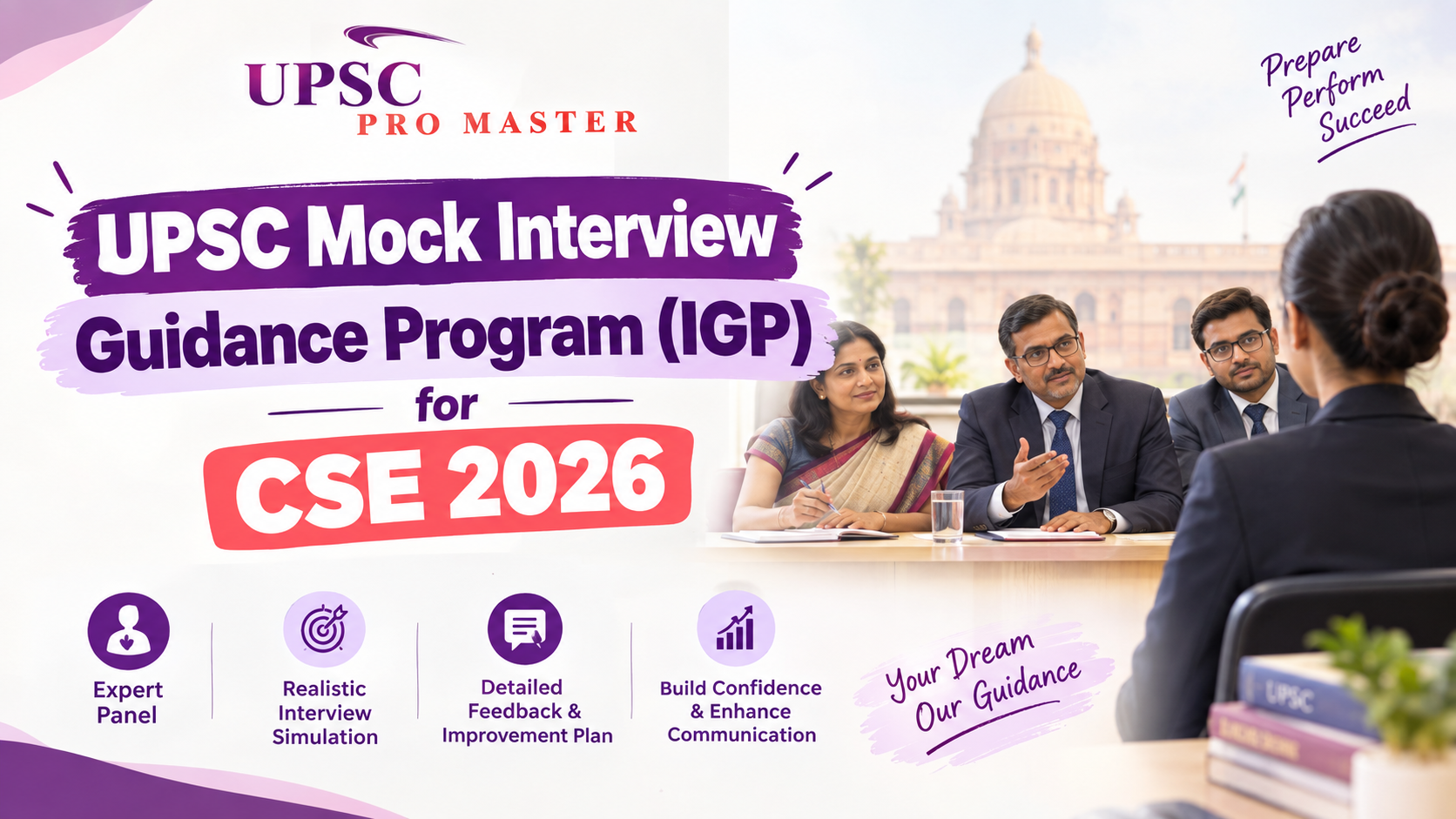
The UPSC interview is the final stage of the Civil Services Examination and an important opportunity for candidates to demonstrate their personality, judgement, communication skills and suitability for public service. Unlike Prelims and Mains, the final stage is not simply about recalling information. The candidate is expected to respond naturally, think clearly and present balanced views on different issues.
For CSE 2026 aspirants, preparation for the UPSC Personality Test should therefore go beyond reading current affairs or collecting expected questions. Candidates need to understand their own Detailed Application Form (DAF), practise answering unpredictable questions, improve communication and learn how to handle follow-up questions calmly.
This is where a structured UPSC Mock Interview Guidance Program (IGP) becomes valuable.
upscinterviewpro focuses on helping serious CSE 2026 candidates prepare for the interview stage through a practical approach built around DAF-based preparation, mock interview practice, feedback, communication and personality development.
UPSC Interview for CSE 2026
The UPSC interview is formally known as the Personality Test. It comes after the written stages of the Civil Services Examination for candidates who qualify for the final stage.
The purpose of the interview is different from a conventional academic viva. A candidate is not expected to simply demonstrate how much information they have memorised. The interaction gives the board an opportunity to assess qualities that are important for a career in civil services.
These include:
- Clarity of thought
- Logical reasoning
- Awareness of contemporary issues
- Ability to analyse situations
- Balance in opinions
- Communication skills
- Emotional maturity
- Confidence without arrogance
- Honesty and integrity
- Interest in public issues
- Ability to respond under pressure
The official UPSC framework describes the interview as a Personality Test, and the interview carries 275 marks without a separate minimum qualifying mark in the established examination scheme.
The important point for CSE 2026 candidates is simple: the interview is not another written examination. It is an assessment of how you think, communicate and respond as a potential civil servant.
UPSC Mock Interview: What Does It Mean?
A UPSC Mock Interview is a simulated interview designed to recreate the environment of the actual Personality Test.
The candidate sits before an interview panel and responds to questions covering different aspects of their profile, knowledge and opinions. Questions may move quickly from the DAF to current affairs, from an optional subject to a hometown issue, or from a factual question to a situation requiring judgement.
The purpose is not to predict the exact questions that will be asked by UPSC.
The real purpose of a UPSC Mock Interview is to identify how a candidate performs when faced with pressure, uncertainty and continuous questioning.
A useful mock should help answer questions such as:
- Do you answer the question directly?
- Are your answers unnecessarily long?
- Can you explain an opinion logically?
- Do you remain calm when challenged?
- Can you acknowledge that you do not know something?
- Do you listen carefully before answering?
- Are your opinions balanced?
- Does your body language support your communication?
- Can you handle cross-questioning?
- Are your answers consistent with your DAF?
This is why simply attending several mock interviews without analysing feedback may not produce meaningful improvement.
The quality of the feedback matters as much as the mock itself.
UPSC Personality Test: What Does the Board Look For?
The UPSC Personality Test should not be treated as a competition to give the most complicated answer.
A simple, relevant and well-reasoned answer is often more effective than a lengthy response filled with difficult terminology.
The candidate's personality becomes visible through small details. The way a candidate listens, pauses, disagrees, accepts a correction, handles an unfamiliar question and explains an opinion can reveal much more than a memorised answer.
A strong candidate should therefore demonstrate:
Clarity
Answer what has actually been asked. Do not take every question as an opportunity to deliver a prepared speech.
Balance
On controversial issues, avoid extreme conclusions unless there is a strong reason for taking a particular position. Explain the issue from different perspectives before reaching a practical conclusion.
Honesty
If you do not know an answer, accepting it politely is better than inventing information.
Awareness
Current affairs preparation should help you understand issues rather than memorise headlines.
Maturity
The board may intentionally challenge your opinion. Disagreement should be handled respectfully.
Confidence
Confidence means being comfortable with your reasoning. It does not mean trying to dominate the conversation.
Why DAF Is Important for UPSC Interview Preparation
Your Detailed Application Form is one of the most important foundations of your UPSC interview preparation.
Candidates sometimes spend considerable time studying national and international current affairs but fail to prepare adequately for their own DAF.
This can create an avoidable problem.
Every detail mentioned in the DAF can become a possible area of discussion.
Your preparation should therefore cover:
- Name and meaning of your name
- Educational qualification
- Graduation subject
- Post-graduation, if applicable
- Optional subject
- Home state
- District
- Current place of residence
- Work experience
- Hobbies
- Extra-curricular activities
- Achievements
- Service preferences
- Cadre-related preferences
- Areas of interest
- Personal experiences mentioned in the DAF
For example, a candidate mentioning photography as a hobby should understand basic photography concepts and be able to discuss why the hobby interests them.
A candidate mentioning a particular district should know its important economic, social, geographical and administrative characteristics.
A candidate with professional experience should be prepared for questions connecting that experience with public administration.
This is why DAF analysis should be personal rather than generic.
How to Prepare for a UPSC Mock Interview
Effective preparation for a UPSC Mock Interview begins well before sitting in front of the panel.
1. Analyse Your DAF
Read every line of your DAF carefully.
For each detail, ask:
What can the board ask from this?
Then prepare both direct questions and possible follow-up questions.
Do not prepare only one answer. A real conversation can move in several directions.
2. Prepare Your Hometown and State
Your hometown and state are highly relevant areas for interview preparation.
Study important issues related to:
- Economy
- Agriculture
- Industries
- Education
- Health
- Environment
- Infrastructure
- Tourism
- Culture
- Employment
- Urbanisation
- Governance
Do not simply memorise statistics. Understand the problems and think about realistic solutions.
3. Prepare Current Affairs Differently
Current affairs for the UPSC interview should not be prepared exactly like Prelims or Mains.
Instead of asking only:
What happened?
Ask:
Why did it happen?
What are its implications?
What are the competing perspectives?
What should the government do?
What could be the practical challenges?
This approach helps you handle follow-up questions naturally.
4. Practise Speaking
Reading answers silently is not enough.
Speak your answers aloud.
Record yourself and evaluate:
- Speed
- Clarity
- Repetition
- Unnecessary pauses
- Filler words
- Voice modulation
- Answer length
- Confidence
- Body language
The objective is not to sound rehearsed. The objective is to sound clear and natural.
5. Practise Unpredictable Questions
Do not prepare only expected questions.
A good UPSC Mock Interview should expose you to unexpected questions because the actual board may change the direction of the conversation quickly.
Practise questions that require you to think rather than recall.
For example:
What is the biggest administrative challenge facing your district?
There may not be one perfect answer.
The quality of your reasoning matters more than using a predetermined sentence.
What Makes a Good UPSC Mock Interview?
A meaningful UPSC Mock Interview should replicate the pressure and unpredictability of the actual Personality Test while still giving the candidate useful feedback.
A strong mock interview should include:
DAF-Based Questioning: Questions should be connected with the candidate's actual background rather than being completely generic.
Cross-Questioning: The candidate should experience follow-up questions instead of answering isolated questions one after another.
Current Affairs: Questions should connect contemporary issues with the candidate's academic, professional or personal background wherever relevant.
Opinion-Based Questions: Candidates should practise giving balanced opinions on issues where multiple perspectives exist.
Situational Questions: Questions involving administrative judgement can help candidates practise decision-making and prioritisation.
Detailed Feedback: The candidate should understand not only what went wrong but also how to improve it.
Personality Assessment: Communication, confidence, body language, listening ability and overall presentation should be assessed along with content.
Leading interview programs similarly emphasise components such as DAF analysis, mock panels, one-to-one mentoring, current-affairs preparation and performance feedback.
How to Answer Questions in the UPSC Personality Test
There is no single formula that can answer every question in the UPSC Personality Test.
However, candidates can follow a simple principle:
Understand → Answer → Explain → Conclude
Start with the direct answer.
Then provide the reasoning.
Add an example or relevant fact when it genuinely strengthens the response.
For opinion-based questions, acknowledge relevant alternative perspectives and finish with a practical conclusion.
For example, if the board asks whether technology can replace human administrators, do not immediately give an extreme yes or no.
A better approach is to explain that technology can improve efficiency, data-based decision-making and service delivery, but human judgement remains important for complex social, ethical and contextual decisions.
The answer becomes stronger because it recognises both opportunity and limitation.
What If You Do Not Know an Answer?
One of the most important lessons in the UPSC interview is knowing how to handle uncertainty.
You do not need to know everything.
If you genuinely do not know the answer, do not guess confidently.
You can politely say:
“Sorry Sir/Ma'am, I am not aware of the exact information.”
If you know something related but are unsure about the specific fact, make the distinction clear.
The objective should be honesty rather than creating an impression of unlimited knowledge.
Trying to bluff can lead to further questions and make the situation more difficult.
Common Mistakes in UPSC Mock Interview
Candidates often make the same mistakes during interview preparation.
Memorising Model Answers: Prepared frameworks are useful, but memorised sentences can sound artificial.
Ignoring the DAF: Preparing only current affairs while ignoring your own profile leaves a major preparation gap.
Giving Very Long Answers: A long answer is not automatically a better answer.
Answer the question first and stop when the point has been adequately explained.
Trying to Impress the Board: The objective is not to use the most complicated vocabulary or display maximum knowledge.
The objective is to communicate clearly.
Becoming Defensive: If the panel challenges your opinion, listen carefully and respond logically.
Guessing Facts: Do not manufacture an answer simply because you feel pressured to respond.
Having Extreme Opinions: Administrative decision-making often requires balancing competing interests. Demonstrating this balance is important.
Taking Too Many Mocks Without Improvement: Ten mocks do not automatically provide ten times the benefit.
Each mock should identify specific areas for improvement.
Best UPSC Interview Preparation Strategy for CSE 2026
A practical preparation strategy can be divided into four stages.
Stage 1: DAF Preparation
Start with yourself.
Analyse every detail in the DAF and create possible questions.
Prepare your education, hometown, state, optional subject, hobbies, work experience and other relevant details.
Stage 2: Current Affairs Preparation
Focus on major national and international developments.
For each important issue, understand:
Background → Current Situation → Stakeholders → Challenges → Government Response → Way Forward
This creates a framework that can be adapted during the interview.
Stage 3: Personality and Communication
Practise speaking every day.
Work on clarity, listening, posture, eye contact, tone and answer structure.
Do not try to change your personality completely.
The objective is to present your genuine personality more effectively.
Stage 4: Mock Interviews and Feedback
Take quality UPSC Mock Interview sessions.
After every mock, maintain a feedback sheet.
Record:
- Questions you could not answer
- Answers that were too long
- Factual gaps
- Communication problems
- DAF areas requiring more preparation
- Current-affairs gaps
- Body-language issues
- Repeated mistakes
Then work specifically on those areas before the next mock.
This turns mock interviews into an improvement process rather than a simple practice activity.
UPSC Interview Preparation with upscinterviewpro
upscinterviewpro is focused specifically on helping UPSC aspirants prepare for the final interview stage.
The approach is centred on the areas that matter most during the Personality Test: understanding the candidate's DAF, practising realistic interview situations, improving answer quality and developing confidence without making responses artificial.
The objective is not to teach candidates a fixed set of answers.
It is to help candidates understand how to approach different types of questions.
A candidate should be able to face a question they have never seen before and still construct a sensible response.
That ability comes from understanding rather than memorisation.
For serious CSE 2026 aspirants, the preparation can focus on:
- DAF-based interview preparation
- Personalised question preparation
- UPSC Mock Interview practice
- Current-affairs discussion
- Opinion-based questions
- Situational questions
- Cross-questioning
- Communication improvement
- Body-language awareness
- Detailed feedback
- Confidence building
The emphasis should remain on improving the candidate from one session to the next.
Feedback Matters More Than the Number of Mocks
A common misconception is that taking more mocks automatically increases the chances of success.
The real benefit comes from what happens after the mock.
Suppose a candidate gives a 30-minute mock interview but receives no meaningful feedback. The same mistakes may appear again in the next session.
Now consider a mock where the candidate is told that:
- answers are too long,
- the opening is unclear,
- opinions need greater balance,
- DAF preparation is incomplete,
- current-affairs understanding is factual rather than analytical,
- and communication becomes hurried under pressure.
The candidate now has specific areas to work on.
The next mock can measure whether those weaknesses have improved.
This feedback loop is one of the most important parts of effective UPSC interview preparation.


