

 Offline/Online Class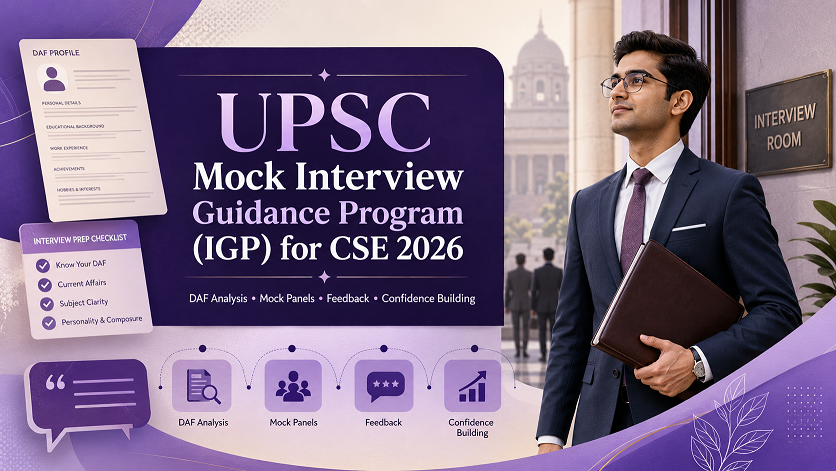
The UPSC interview is the final and most personality-driven stage of the Civil Services Examination. After clearing Prelims and Mains, candidates reach a stage where marks are not given only for information. The board observes how a candidate thinks, speaks, reacts, listens, analyses issues, and presents a balanced administrative personality. This is why a structured UPSC Mock Interview Guidance Program (IGP) for CSE 2026 becomes highly important for serious aspirants.
A good Interview Guidance Program solves these problems through DAF analysis, mock interviews, personal feedback, current affairs discussion, and confidence-building sessions.
UPSC Mock Interview Guidance Program
The UPSC Mock Interview Guidance Program is a focused preparation program for candidates appearing in the final stage of the Civil Services Examination. It helps aspirants prepare for the real UPSC interview environment through expert-led mock interview panels, personalised mentoring, DAF-based question preparation, communication improvement, and detailed feedback.
The aim of the program is not to make candidates memorise ready-made answers. The real purpose is to help candidates present their own personality in a mature, honest, and confident manner. The UPSC board does not expect a perfect person. It expects a balanced person who can think logically, accept limitations, respect different views, and respond with administrative maturity.
For CSE 2026 aspirants, IGP should be treated as a serious preparation stage, not as a last-minute formality. A well-planned UPSC mock interview gives candidates the required exposure before the actual board interaction.
UPSC Interview Important
The UPSC interview can strongly influence the final rank, service allocation, and overall selection outcome. At this stage, almost every candidate has already proved academic ability by clearing Mains. The real difference comes from personality, clarity, confidence, awareness, and judgement.
The UPSC personality test checks whether a candidate has the qualities required for public service. These qualities include mental alertness, social awareness, emotional stability, leadership ability, ethical thinking, communication skill, and problem-solving approach. A candidate may not know every answer, but the way the candidate handles uncertainty matters a lot.
This is why upsc interview preparation should be different from Prelims and Mains preparation. It should not be limited to reading newspapers or collecting facts. It must include speaking practice, answer structuring, DAF preparation, opinion formation, and regular feedback.
Importance of DAF in UPSC Interview Preparation
The Detailed Application Form, or DAF, is the backbone of the UPSC interview. It contains the candidate’s name, educational background, home state, district, optional subject, work experience, hobbies, achievements, service preferences, and other personal details. The board can ask questions from any section of the DAF.
For example, if a candidate mentions “reading” as a hobby, the board may ask about recent books, favourite authors, reading habits, or the role of literature in society. If a candidate belongs to Uttar Pradesh, Bihar, Rajasthan, Maharashtra, Tamil Nadu, or any other state, questions may come from state economy, culture, governance challenges, social issues, tourism, agriculture, or development indicators.
A good UPSC Mock Interview Guidance Program prepares candidates for such questions in a systematic way. It helps them understand why a question may be asked and how to answer it without sounding artificial. DAF-based preparation also improves self-awareness, which is one of the most important qualities in the interview stage.
What Makes a Good UPSC Mock Interview?
A good UPSC mock interview should create an environment close to the actual personality test. The panel should ask questions from DAF, current affairs, optional subject, graduation background, hobbies, ethics, governance, and situational areas. The questions should test not only knowledge but also attitude, clarity, patience, and decision-making.
The most useful mock interview is not the one where the candidate feels comfortable throughout. It is the one that identifies real weaknesses. Some candidates give very long answers. Some speak too fast. Some become defensive during counter-questions. Some use technical language unnecessarily. Some avoid eye contact or lose confidence after one difficult question.
A strong IGP gives practical feedback on these issues. It tells the candidate where the answer was strong, where it became vague, where the tone was weak, and how the same answer can be improved. This feedback-based correction is the biggest advantage of joining a professional Interview Guidance Program.
Key Features of UPSC IGP for CSE 2026
A complete UPSC Mock Interview Guidance Program for CSE 2026 should include more than one mock session. It should provide a full preparation ecosystem for the UPSC personality test.
The first feature should be detailed DAF analysis. Every candidate must receive personalised questions based on background, state, district, education, optional subject, hobbies, work experience, and service preference.
Read This also –
Is Hijab Allowed in UPSC Interview?
The second feature should be current affairs orientation. The UPSC interview often connects personal background with national and international issues. Candidates should be ready to discuss topics like governance reforms, economy, technology, environment, internal security, social justice, ethics, federalism, and India’s foreign policy.
The third feature should be communication improvement. The board observes how clearly a candidate speaks. A good answer should be short, structured, polite, and relevant. Candidates should learn how to begin an answer, how to handle cross-questioning, and how to say “I do not know” gracefully.
The fourth feature should be one-to-one mentorship. General guidance is useful, but personal mentoring gives direction according to the candidate’s specific weaknesses. Some candidates need content improvement, some need confidence building, some need body language correction, and some need help in forming balanced opinions.
Mistakes Candidates Avoid
One major mistake is memorising answers word by word. The UPSC interview is a conversation, not a speech. Memorised answers sound unnatural and may create a negative impression.
Another mistake is ignoring the DAF. Many candidates prepare current affairs but fail to answer basic questions about their own background. This shows lack of seriousness.
Some candidates also try to answer every question even when they do not know the correct answer. This is risky. It is better to honestly accept that you do not know something than to give a wrong or imaginary answer.
Overconfidence is also harmful. The board appreciates confidence, but not arrogance. A future civil servant must show humility, patience, and willingness to learn.
Prepare for UPSC Interview 2026
Start by reading your DAF line by line. Prepare possible questions from every word. Revise your graduation subject, optional subject, state, district, hobbies, and work experience. Make short notes, but do not memorise full scripts.
Next, prepare current affairs with an interview mindset. Focus on causes, impact, challenges, government response, and way forward. Try to build balanced opinions on major national and international issues.
Practise speaking every day. Record your answers and check your clarity, speed, tone, and structure. Your answers should be direct, calm, and meaningful. Avoid unnecessary examples and long explanations.
Finally, take quality mock interviews. A good UPSC Mock Interview Guidance Program exposes you to different types of questions and board styles. It improves confidence and reduces fear before the actual UPSC personality test.
Join the IGP for CSE 2026
Candidates who have cleared Mains or are preparing seriously for the final stage should join an Interview Guidance Program. It is especially useful for candidates who feel nervous while speaking, struggle with opinion-based questions, lack DAF clarity, or want expert feedback before the actual interview.
Also Read This –
UPSC Interview Preparation: Why First-Time Candidates Face Problems
Even confident candidates benefit from mock interviews because confidence without direction can become overconfidence. IGP helps candidates refine their personality, improve answer quality, and present themselves with maturity.
The UPSC Mock Interview Guidance Program (IGP) for CSE 2026 is not just about facing a practice board. It is about understanding yourself, improving your communication, preparing your DAF, building balanced opinions, and developing the right administrative temperament.
The UPSC interview is not designed to reject candidates for not knowing one fact. It is designed to assess whether they are suitable for public service. With proper upsc interview preparation, regular feedback, and realistic mock interview practice, candidates can enter the UPSC personality test with confidence, clarity, and composure.
A good IGP does not change your personality. It refines your personality and helps you present your best self before the UPSC board.


