

 Offline/Online Class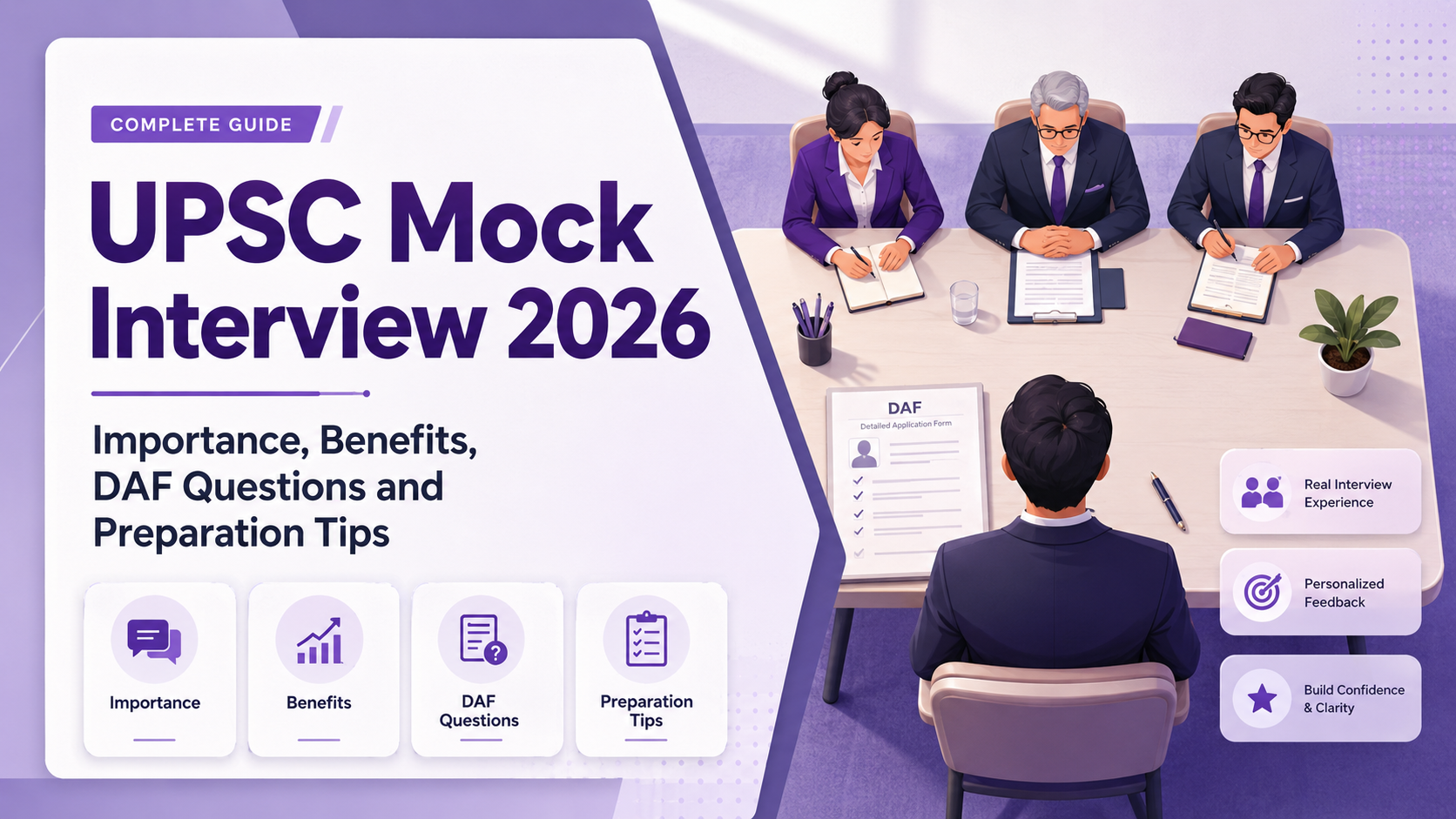
The UPSC mock interview is one of the most important parts of preparation for candidates who have cleared the Civil Services Mains Examination and are preparing for the final Personality Test. Many aspirants spend years preparing for Prelims and Mains, but the interview stage requires a completely different skill set. It is not only about what you know; it is also about how you think, speak, respond, behave and handle pressure.
The UPSC interview, also known as the Personality Test, evaluates the overall personality of a candidate. The board looks for clarity of thought, honesty, emotional balance, awareness, communication skills, presence of mind and administrative suitability. A candidate may have strong knowledge but may still perform poorly if the answer is unclear, too long, overconfident, defensive or unbalanced.
This is where a UPSC mock interview becomes highly useful. It gives aspirants a real interview-like experience before the final day. It helps them understand their strengths, identify weak areas, improve DAF-based answers, handle cross-questioning, build confidence and develop a mature administrative approach.
For serious aspirants, a mock interview is not just practice. It is the final bridge between written preparation and personality-based evaluation.
UPSC Mock Interview
A UPSC mock interview is a simulated interview conducted to prepare candidates for the actual UPSC Personality Test. It is usually conducted by a panel that asks questions similar to those asked in the real interview.
Read This –
UPSC Mock Interview: Why It Matters and How to Prepare
The questions may come from:
Detailed Application Form
Home state and district
Educational background
Optional subject
Work experience
Hobbies and interests
Current affairs
National and international issues
Ethical situations
Administrative decision-making
Service preference
Cadre preference
The purpose of a mock interview is not to test memorised information. Its real purpose is to evaluate whether the candidate can think clearly, speak confidently and answer questions with balance and maturity.
A good UPSC mock interview helps candidates understand how their personality appears before an interview panel. It also helps them improve their answer structure, tone, body language and presence of mind.
UPSC Mock Interview Important?
The UPSC interview is different from Prelims and Mains. In Prelims, candidates solve objective questions. In Mains, they write analytical answers. But in the interview, candidates must respond naturally in a face-to-face conversation.
This makes the interview stage unique. The board does not expect the candidate to know everything. It expects honesty, humility, awareness, confidence and balanced judgement.
A UPSC mock interview is important because it prepares candidates for this real situation. It helps them face difficult questions, manage nervousness, improve communication and avoid common mistakes.
Many candidates perform below their potential in the interview not because they lack knowledge, but because they lack practice. They may speak too much, become nervous, give one-sided opinions, defend a weak answer or fail to present their thoughts clearly.
Mock interviews help correct these mistakes before the actual Personality Test.
Benefits of UPSC Mock Interview
1. Real Interview Experience
A UPSC mock interview creates an interview-like environment. Candidates learn how to enter the room, greet the panel, sit properly, listen carefully, answer confidently and maintain professional behaviour.
This experience is extremely useful because many aspirants feel nervous when they face a formal panel for the first time. After attending mock interviews, the fear of the interview room gradually reduces.
By the time candidates appear for the actual UPSC interview, they become more comfortable with the process.
2. Better DAF-Based Preparation
The Detailed Application Form, commonly known as DAF, is one of the most important sources of UPSC interview questions. The interview board may ask questions from every important detail mentioned in the DAF.
3. Improved Confidence
Confidence is one of the biggest requirements for the UPSC interview. But real confidence does not come from memorizing answers. It comes from preparation, practice, correction and repeated exposure to interview-like situations.
A UPSC mock interview helps candidates speak before a panel and receive feedback. After every mock, candidates understand what they are doing well and what needs improvement.
This process builds natural confidence. Candidates become more comfortable while answering questions and handling counter-questions.
4. Better Communication Skills
The UPSC interview does not require complicated English or decorative vocabulary. It requires clear, simple, respectful and meaningful communication.
A good interview answer should be:
Short
Clear
Relevant
Balanced
Honest
Polite
Logical
Many aspirants know the answer but fail to communicate it properly. Some speak too fast. Some use very long sentences. Some repeat the same point again and again. Some use bookish language that sounds unnatural.
Mock interviews help candidates improve their speaking style. They learn how to organise thoughts and present them in a simple and effective manner.
5. Pressure Handling Ability
The UPSC interview board may ask unexpected questions. Sometimes, the candidate may not know the answer. Sometimes, the board may challenge the candidate’s opinion. Sometimes, one answer may lead to several follow-up questions.
A UPSC mock interview prepares candidates for such pressure situations.
It teaches them how to stay calm, listen carefully, think before answering and respond with maturity. It also teaches candidates that saying “I do not know” is better than giving a wrong or fake answer.
The board values honesty. A candidate should never bluff or guess unnecessarily.
6. Improved Body Language
Body language plays an important role in the UPSC interview. It reflects confidence, discipline, seriousness and emotional balance.
A mock interview helps candidates correct body language mistakes such as:
Poor eye contacts
Nervous hand movement
Low voice
Casual sitting posture
Interrupting the panel
Speaking too aggressively
Looking confused or restless
A candidate’s body language should be calm, respectful and natural. Mock interviews help aspirants develop this professional appearance.
7. Stronger Current Affairs Answers
Current affairs are very important for the UPSC interview. But interview current affairs are different from Prelims and Mains current affairs.
In Prelims, candidates focus on facts. In Mains, they write analytical answers. In the interview, they must express balanced opinions.
8. Development of Administrative Thinking
The UPSC interview is designed to assess whether a candidate has the qualities required for public service. A future civil servant must be practical, ethical, empathetic and solution-oriented.
A UPSC mock interview helps candidates develop administrative thinking. It trains them to answer not only like a student, but like a responsible future officer.
For example, if a question is asked about handling a protest, the answer should not be emotional or extreme. It should reflect rule of law, dialogue, public safety, constitutional rights and peaceful resolution.
This type of balanced thinking improves the overall quality of answers.
9. Identification of Weak Areas
Every candidate has different weaknesses. Some candidates are weak in current affairs. Some are not confident in speaking. Some have poor DAF preparation. Some give long answers. Some become defensive during counter-questions.
A UPSC mock interview helps identify these weaknesses early.
Once the weakness is known, the candidate can work on it. Without mock practice, candidates may realise their mistakes only during the actual interview, which is too late.
10. Personalized Feedback
One of the biggest benefits of a UPSC mock interview is feedback. A good mock interview panel does not only ask questions; it also guides candidates on improvement.
Feedback may include:
Your answers are too long.
Your introduction needs improvement.
Your DAF preparation is weak.
Your current affairs answers need balance.
Your body language looks nervous.
Your opinions sound extreme.
Your examples are not strong.
Your answers sound memorised.
UPSC Interview Pro gives importance to personalised feedback because every candidate has a different background, personality and preparation level. Personalised feedback helps aspirants improve in the exact areas where they are weak.
Prepare for UPSC Mock Interview
1. Read Your DAF Line by Line
Your DAF is the foundation of your UPSC interview preparation. Before attending any mock interview, read your DAF carefully.
Prepare questions from every detail you have written. Do not ignore small details because the board can ask questions from any part of your profile.
Your DAF answers should be original. Do not copy answers from other candidates. Your background is unique, so your answers should also reflect your real personality.
2. Prepare Your Home State and District
Questions from home state and district are very common in the UPSC interview. Candidates should prepare both factual and analytical points.
Prepare these areas:
History
Geography
Economy
Culture
Tourism
Famous personalities
Major crops
Industries
Social issues
Development challenges
Administrative problems
Recent news
You should be able to explain both strengths and weaknesses of your region.
For example, if your district has good agricultural potential but poor industrial development, you should be able to explain the reasons and possible solutions.
3. Prepare Your Graduation Subject
The board may ask questions from your graduation subject even if it is not your optional subject. Candidates should revise basic concepts and current relevance of their academic background.
Prepare questions like:
Why did you choose this subject?
How is your graduation subject useful in administration?
What are its current applications?
How can your academic knowledge help in public service?
The aim is not to revise the full syllabus, but to prepare important concepts and their practical relevance.
4. Prepare Your Optional Subject
Your optional subject shows your academic interest and depth. The board may ask conceptual, applied or current-related questions from your optional subject.
Prepare the major themes, thinkers, theories, case studies and current linkages of your optional subject.
For example, a Geography optional candidate may be asked about climate change, urbanisation, disaster management, water crisis, regional planning or migration.
5. Prepare Current Affairs with Balanced Views
For UPSC interview preparation, current affairs should be prepared with opinion formation. Do not only collect facts. Try to develop a balanced view on major issues.
6. Practise Speaking Answers
Interview preparation cannot be completed only by reading. You must practise speaking.
Choose common UPSC interview questions and answer them aloud. Record your voice and listen to it. Check whether your answer is clear, short and confident..
7. Keep Answers Short and Natural
A common mistake in the UPSC mock interview is giving very long answers. The interview is a conversation, not a speech.
A good answer should usually follow this structure:
Direct answer
Brief explanation
Balanced conclusion
Do not try to show all your knowledge in one answer. Answer only what is asked.
8. Work on Body Language
Before attending the mock interview, work on your body language. Sit straight, maintain calm eye contact, listen carefully and avoid unnecessary hand movements.
Your tone should be polite and respectful. Do not sound arrogant or casual. Also, do not become too submissive. A balanced personality is important.
9. Analyze Feedback After Every Mock
The real value of a UPSC mock interview comes after the interview. After every mock, note down your mistakes and improvement areas.
Also Read This –
UPSC Interview Preparation: Why First-Time Candidates Face Problems
Role of UPSC Interview Pro in Mock Interview Preparation
UPSC Interview Pro helps aspirants prepare for the Personality Test through DAF-based mock interviews, board-style questioning, personalized feedback and practical preparation guidance.
Its focus is on helping candidates present their real personality with clarity, honesty, balance and confidence. A good mock interview should not create fear. It should help the candidate understand mistakes and improve performance before the final interview.
For candidates who want structured UPSC interview preparation, UPSC Interview Pro can help in DAF analysis, answer framing, communication improvement and interview confidence building.
A UPSC mock interview is an essential part of UPSC interview preparation. It helps candidates understand the real nature of the Personality Test and prepares them for DAF-based questions, current affairs questions, opinion-based questions and situational questions.
The biggest benefit of a mock interview is that it converts preparation into performance. It improves confidence, communication, body language, clarity of thought and self-awareness.
Candidates who take mock interviews seriously, analyse feedback properly and improve consistently can enter the actual UPSC interview with better confidence and maturity.
For serious aspirants, a UPSC mock interview is not just practice. It is the final bridge between Mains success and final selection.
If you want structured guidance, DAF-based preparation and interview-style practice, UPSC Interview Pro can help you prepare with a focused and personalised approach for the UPSC Personality Test.


