

 Offline/Online Class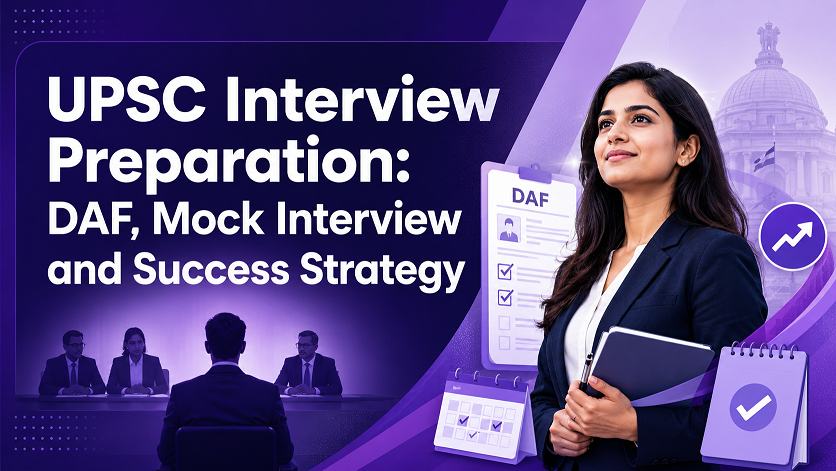
The UPSC interview, officially called the Interview/Personality Test, is the final stage of the Civil Services Examination. It carries 275 marks and has no minimum qualifying marks, but its score is added to the written Mains total for final ranking.
UPSC does not treat the personality test as a strict cross-examination or another general knowledge paper. The board assesses mental alertness, logical expression, balanced judgement, depth of interest, leadership, social cohesion, and intellectual and moral integrity. Effective UPSC interview preparation must therefore develop self-awareness, informed opinions, clear communication, and calm decision-making rather than memorised answers.
Start UPSC Interview Preparation with Your DAF
Your Detailed Application Form is the most personal part of your preparation. Every entry can generate questions, including your name, hometown, state, education, optional subject, employment, achievements, hobbies, service preference, and cadre preference.
Create a question bank for each DAF entry. For your district and state, study geography, history, economy, culture, industries, development indicators, administrative challenges, and recent issues.
Graduates should revise the fundamentals of their subject and its practical application. Working candidates must prepare their job responsibilities, professional achievements, workplace challenges, and reasons for moving from a private or specialised career to civil services.
Prepare hobbies honestly. If you mention reading, music, cricket, travelling, photography, or fitness, understand its basic concepts, recent developments, notable personalities, and personal significance.
Prepare Current Affairs for Conversation
Current affairs for the UPSC interview require analysis rather than note reproduction. Focus on major national, international, economic, social, environmental, scientific, and governance issues. Prioritise developments connected with your state, education, work, and service choices.
For every important issue, prepare five elements: context, key facts, stakeholders, arguments on different sides, and a practical way forward.
Use a simple answer framework: position, reasons, counterview, and conclusion. Begin with your considered view, support it with two reasons, acknowledge a valid limitation, and suggest an administratively feasible solution. Avoid ideological rigidity. A civil servant must balance legality, public interest, compassion, resources, and implementation constraints.
Use a UPSC Mock Interview Effectively
A UPSC mock interview should identify weaknesses, not produce rehearsed answers. Attend a limited number of quality mocks and leave enough time between sessions to apply feedback.
Choose panels that provide specific feedback on DAF coverage, content accuracy, answer structure, listening ability, tone, body language, and administrative judgement. Record the session when permitted. Review posture, expressions, clarity, pace, filler words, and answer length.
After each UPSC mock interview, create an improvement sheet under four headings: knowledge gaps, communication problems, behavioural habits, and weak DAF areas. Convert general comments into measurable actions. “Improve confidence” is vague; “pause briefly, reduce filler words, and answer within ninety seconds” is actionable.
Do not copy another candidate’s speaking style. Accept feedback that is repeated, evidence-based, and suitable for your natural temperament.
Improve Communication and Body Language
Listen to the complete question before answering. A brief pause shows composure and prevents misinterpretation. Start with the main point instead of a long introduction. Use short sentences, maintain a moderate pace, and stop when the answer is complete.
Sit upright but relaxed. Maintain natural eye contact with the member asking the question. Avoid folded arms, constant hand movement, tapping, forced smiling, and argumentative gestures.
Confidence does not mean answering everything. It means remaining composed whether you know the answer or not. Respectful disagreement is acceptable when supported by reasons.
Also Read This –
Expert Mentors for UPSC Interview | Personal Guidance
30-Day Preparation Plan
During days 1–7, analyse every DAF entry and build a question bank. Revise your district, state, graduation subject, optional subject, work experience, hobbies, and service preferences.
During days 8–15, prepare issue briefs for important current affairs. Practise two-minute responses and connect national issues with constitutional values and administrative realities.
During days 16–23, attend selected mock interviews, review recordings, and correct repeated weaknesses. Practise situations involving law and order, disaster management, welfare delivery, corruption, political pressure, and conflict resolution.
During days 24–30, consolidate notes instead of adding excessive material. Revise your DAF, practise difficult questions, arrange documents, maintain sleep, and reduce anxiety through a stable routine.
Mistakes
Do not memorise model answers word for word. Avoid lengthy speeches, uncertain data, extreme opinions, exaggerated achievements, and invented interests. Do not defend an incorrect answer or treat the discussion as a debate that must be won.
Attending too many mocks is another mistake. Conflicting feedback can make responses mechanical.
FAQs
How many marks does the UPSC interview carry?
The Interview/Personality Test carries 275 marks, with no minimum qualifying marks.
Is a UPSC mock interview necessary?
It is not compulsory, but a good mock can identify weaknesses in content, communication, body language, and decision-making.
How should I answer when I do not know something?
Admit it politely and avoid guessing. Honest uncertainty is better than confident misinformation.
What is the most important area for UPSC interview preparation?
The DAF is the starting point, supported by current affairs, speaking practice, self-awareness, and structured mock feedback.
successful UPSC interview preparation rests on command over the DAF, analytical current affairs, speaking practice, and honest self-evaluation. The board does not expect perfection or encyclopedic knowledge. It looks for a candidate who can think clearly, remain balanced, communicate respectfully, and act with integrity. Prepare deeply, answer naturally, and allow your judgement and authenticity to shape the conversation. Consistency matters more than collecting material or attending frequent mocks.


