

 Offline/Online Class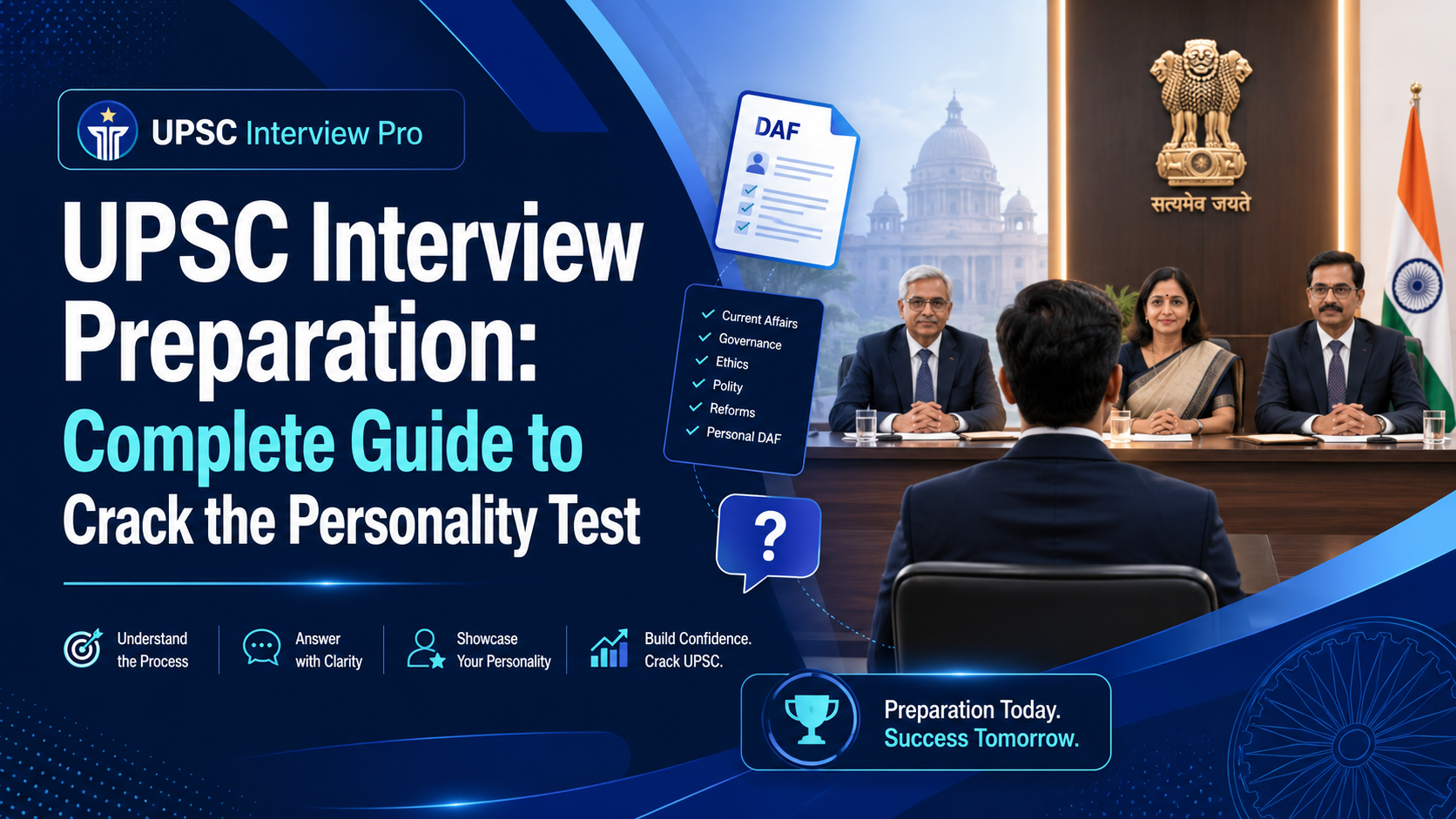
The UPSC interview is the final and most personality-driven stage of the Civil Services Examination. After Prelims and Mains, the board does not only check knowledge. It observes how you think, how calmly you respond, how balanced your opinions are and whether you have the temperament expected from a future civil servant.
The Personality Test carries 275 marks, which are added to the Mains score for the final merit list. This makes UPSC interview preparation very important. A strong interview can improve the final rank, while a weak interview can reduce the advantage of good Mains marks.
At UPSC Interview Pro, the focus is to help candidates present their real personality with clarity, honesty and administrative maturity.
What is the UPSC Interview?
The UPSC interview, officially called the Personality Test, is conducted for candidates who qualify the Civil Services Mains Examination. It is not a test of memorised facts. It is a structured conversation where the board evaluates mental alertness, judgement, leadership qualities, ethical awareness, social sensitivity and clarity of expression.
Questions may come from your Detailed Application Form, education, optional subject, work experience, hobbies, home state, current affairs and national issues. The board may also ask situational questions to understand how you would act as an administrator.
How UPSC CSE Syllabus Helps in the Interview
Many aspirants think the interview has no connection with the UPSC CSE syllabus. This is incorrect. The syllabus remains the foundation of your understanding. Polity helps in governance questions. The economy helps in discussions on inflation, employment and welfare schemes. Ethics helps in case-based questions. International relations help in foreign policy questions. Environment and society help in topics like climate change, social justice and inclusive development.
Therefore, revise the UPSC CSE syllabus from an application perspective: issue, cause, challenge, solution and administrative role.
Step-by-Step UPSC Interview Preparation Strategy
1. Start with Detailed DAF Analysis
Your Detailed Application Form is the basis of the interview. Every word written in it must be prepared. Prepare your name, birthplace, district, state, college, graduation subject, optional subject, hobbies, work experience, service preference and cadre preference.
If your hobby is cricket, prepare rules, recent developments, sports governance and ethical issues in sports. If your district is mentioned, prepare its economy, culture, geography, problems and development opportunities.
2. Prepare Current Affairs with Balanced Opinions
For the UPSC interview, current affairs should not be prepared only through facts. You must develop balanced opinions. For every major issue, prepare background, constitutional angle, viewpoints, challenges and practical solutions.
Avoid extreme, emotional or political statements. A civil servant must sound objective, fair and solution-oriented.
3. Revise Optional and Graduation Basics
The board may ask simple but analytical questions from your optional subject and graduation. You do not need research-level preparation, but your fundamentals should be clear. Connect your subject with current developments wherever possible.
If you do not know an answer, say it politely. Honest acceptance is better than bluffing.
4. Improve Communication and Body Language
Good communication does not mean difficult vocabulary. It means clear, concise and relevant expression. A strong answer usually has three parts: direct response, short explanation and balanced conclusion.
Maintain eye contact, sit confidently, listen carefully and avoid interrupting the board. Speak naturally.
Importance of UPSC Mock Interview
A UPSC mock interview gives you interview-room exposure before the actual Personality Test. It helps identify weak areas in DAF preparation, current affairs understanding, communication, body language and answer structure.
Feedback quality matters more than the number of mocks. Too many mock interviews can confuse candidates if feedback is not analysed properly. Take a few quality mocks, note repeated observations and work on them systematically.
At UPSC Interview Pro, the UPSC mock interview process includes DAF-based questioning, current affairs discussion, situational questions, communication review and personalised feedback. The goal is to make your natural answers sharper and more mature.
Common Mistakes to Avoid: Step-by-Step Guide
Many candidates lose marks in the UPSC interview not because of a lack of knowledge, but because of avoidable mistakes. Understanding these mistakes in advance can help you perform better on the final day.
Step 1: Do Not Ignore Your DAF
Your Detailed Application Form (DAF) is one of the most important documents for the interview. Every detail mentioned in it can become a question. Many candidates focus only on current affairs and neglect DAF preparation.
What to do:
- Prepare your hometown, district and state thoroughly.
- Revise your educational background and optional subject.
- Be ready to discuss your hobbies, achievements and work experience.
Step 2: Avoid Memorising Model Answers
Some aspirants try to memorise answers from coaching materials or online sources. This often makes responses sound artificial and rehearsed.
What to do:
- Understand issues instead of memorising answers.
- Develop your own balanced viewpoints.
- Speak naturally and confidently during the interview.
Step 3: Do Not Give Long and Unfocused Answers
A common mistake is speaking too much without directly answering the question. Long answers can confuse the board and reduce the impact of your response.
What to do:
- Listen carefully to the question.
- Give a direct answer first.
- Add a brief explanation and conclude clearly.
Step 4: Never Pretend to Know Everything
The interview board understands that no candidate can know every answer. Trying to guess or bluff can create a negative impression.
What to do:
- Admit politely when you do not know something.
- Stay calm and confident.
- Move to the next question without hesitation.
Step 5: Avoid Extreme Opinions
The UPSC board values balanced thinking and administrative maturity. Strong political, emotional or biased statements can be risky.
What to do:
- Present multiple perspectives on an issue.
- Support your views with logic and facts.
- Maintain a neutral and solution-oriented approach.
Step 6: Maintain Honesty and Clarity
The safest strategy throughout the interview is honesty, clarity and moderation. If you know the answer, explain it briefly and confidently. If you have an opinion, support it with reason. If you do not know the answer, accept it respectfully.
Following these steps can help you avoid common interview mistakes and create a positive impression on the UPSC board.
Also Read this - Who Takes Interview in UPSC 2026, Board, Panel Members, Process,
Why Choose UPSC Interview Pro?
UPSC Interview Pro helps aspirants prepare through structured DAF analysis, board-style questioning, personalised feedback and practical improvement plans. The approach focuses on clarity of thought, balanced expression and confidence building.
For serious UPSC interview preparation with a realistic UPSC mock interview experience, UPSC Interview Pro can help you prepare with direction and confidence.
The UPSC interview is not about perfection. It is about personality, judgment, and public service orientation. A strong strategy connects the UPSC CSE syllabus, DAF, current affairs, communication and mock interview feedback. With right guidance and consistent practice, you can enter the interview room with confidence.
FAQs on UPSC Interview Preparation
1. How should I start UPSC interview preparation after Mains?
Start with DAF, home state, optional subject, graduation basics and current affairs. Then take a UPSC mock interview for feedback.
2. Is there a fixed syllabus for the UPSC interview?
There is no fixed interview syllabus, but questions usually come from DAF, current affairs, optional subject, graduation, hobbies, home state and national issues.
3. How many UPSC mock interviews should I take?
Most candidates should take 3 to 5 quality mock interviews. Focus on feedback quality, not quantity.
4. Can I score well in the UPSC interview with average English?
Yes. The board values clarity, honesty, balance and confidence more than decorative English.
5. What should I do if I do not know the answer?
Politely accept that you do not know the exact answer. Do not bluff or guess with overconfidence.


