

 Offline/Online Class
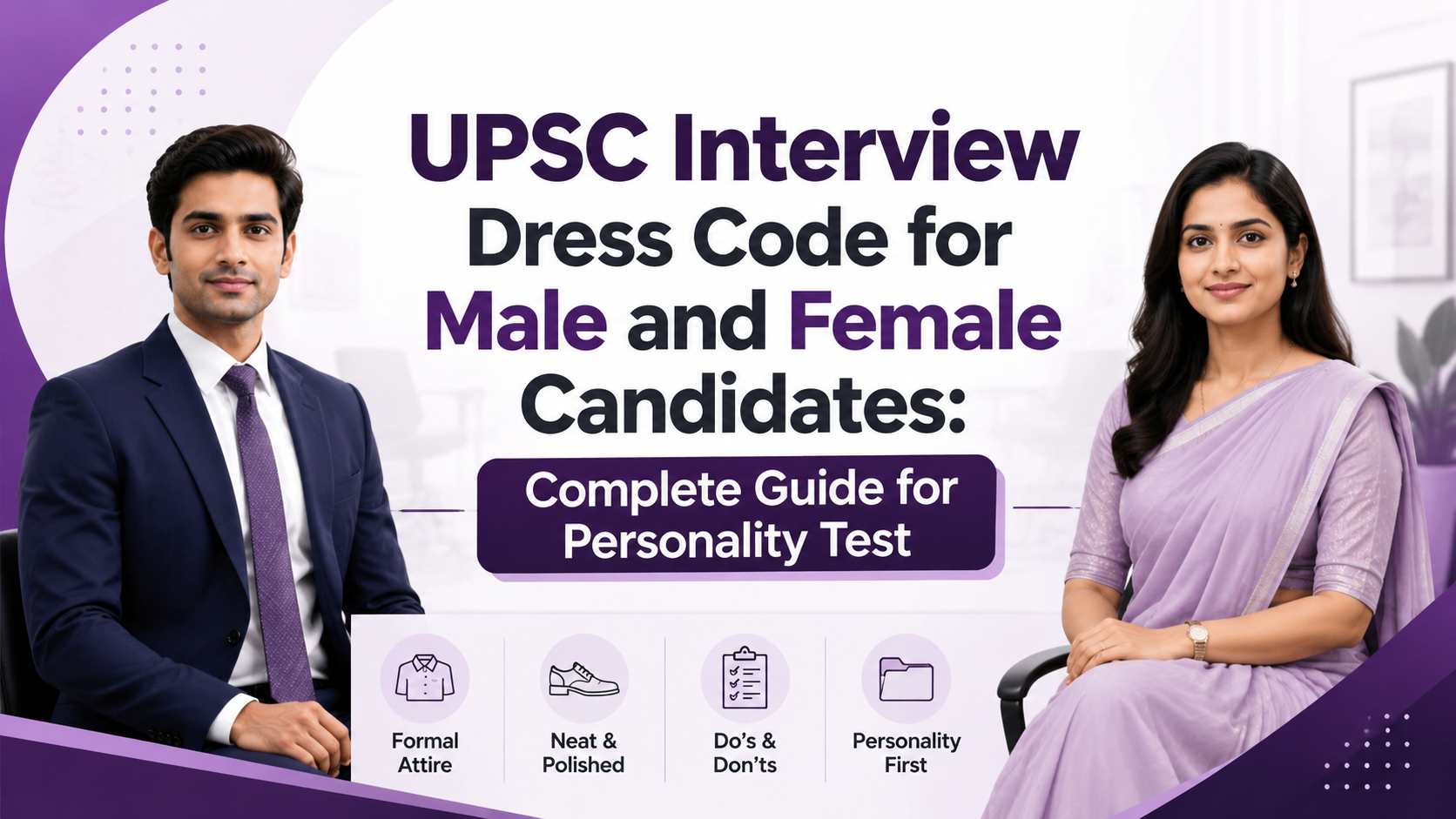
The UPSC interview, officially known as the Personality Test, is the final and most personality-oriented stage of the Civil Services Examination. At this stage, the board evaluates the candidate’s overall suitability for public service through qualities such as clarity of thought, honesty, administrative attitude, emotional balance, awareness, communication ability and decision-making approach.
Best Dress Code for UPSC Interview
The best dress code for the UPSC interview is simple, formal, clean, comfortable and dignified. Candidates should dress in a way that reflects seriousness without looking flashy, artificial or over-styled.
A good UPSC interview dress code should fulfil five conditions:
It should look formal.
It should be clean and properly ironed.
It should be comfortable for sitting and walking.
It should not distract the board.
It should match the dignity of the Personality Test.
Dress Code Matters in UPSC Interview Preparation
Dress code matters because the UPSC interview is a formal constitutional process. The interview setting is serious, structured and professional. A casual or careless appearance may create a weak first impression even before the candidate begins answering.
Read This –
UPSC Interview Preparation: Complete Guide to Crack the Personality Test
UPSC Interview Dress Code for Male Candidates
Male candidates should prefer formal and sober clothing. The most common and safest choice is a full-sleeve formal shirt with formal trousers. A blazer, suit or tie may be added depending on weather, comfort and personal preference.
1. Formal Shirt for Male Candidates
A full-sleeve formal shirt is the best option for most male candidates. It should be clean, ironed and properly fitted. The shirt should not be too tight, too loose or transparent.
Best shirt colours for male candidates:
White
Light blue
Cream
Light grey
Avoid loud prints, large checks, shiny fabric, party-style shirts and very dark colours. A plain or lightly textured shirt looks more professional than a fashionable shirt.
Half-sleeve shirts are generally less formal than full-sleeve shirts. Therefore, full sleeves are safer for the UPSC interview.
2. Formal Trousers for Male Candidates
Male candidates should wear formal trousers in sober colours. The trouser should be well-fitted and comfortable for sitting.
Best trouser colours:
Black
Navy blue
Charcoal grey
Dark grey
Avoid jeans, cargo pants, track pants, casual chinos, tight trousers and flashy colours. The trouser should be pressed properly and should match the shirt.
3. Blazer or Suit for UPSC Interview
A blazer or suit is not compulsory, but it can be worn if the candidate is comfortable. It is more useful during winter or in cold weather.
Best blazer or suit colours:
Navy blue
Charcoal grey
Black
Dark brown
A blazer should fit well. An oversized or tight blazer can make the candidate uncomfortable. If the weather is hot, a clean formal shirt and trousers are enough.
Do not wear a blazer only because other candidates are wearing it. Comfort is more important than copying someone else’s style.
4. Tie for UPSC Interview
A tie is optional. If a candidate chooses to wear a tie, it should be simple and sober.
Best tie choices:
Solid colours
Subtle stripes
Small patterns
Dark blue, maroon, grey or sober shades
Avoid bright red, neon colours, shiny ties, large designs, cartoon prints or party-style ties. A badly tied or uncomfortable tie can become a distraction.
5. Shoes and Socks for Male Candidates
Footwear should be formal, polished and comfortable.
Best shoe options:
Black formal shoes
Dark brown formal shoes
Simple formal loafers
Avoid sports shoes, sneakers, sandals, slippers, floaters and casual footwear.
Socks should be formal and should match the outfit. Black, navy blue, grey or brown socks are safe. Avoid colourful, printed or ankle-length casual socks.
6. Grooming for Male Candidates
Grooming should be neat and natural. Hair should be properly trimmed and combed. Beard is acceptable if it is well-groomed. A clean-shaven look is also fine.
Also Read this –
Is Beard Allowed in UPSC Interview
Basic grooming checklist for male candidates:
Hair should be neat.
Beard should be trimmed or clean-shaven.
Nails should be clean and cut.
Shoes should be polished.
Perfume should be mild or avoided.
Face should look fresh and clean.
Strong perfume should be avoided because the interview room is usually a closed formal space.
UPSC Interview Dress Code for Female Candidates
Female candidates have more formal clothing options than male candidates. They may choose a saree, salwar suit, formal kurta with trousers, or western formal wear. The best choice is the one that is dignified, simple and comfortable.
The outfit should not be too casual, too flashy, too tight or too difficult to manage. The candidate should be able to sit, walk and answer naturally.
1. Saree for Female Candidates
A saree is one of the most graceful and formal choices for the UPSC interview. It gives a dignified appearance if worn simply and comfortably.
Best saree fabrics:
Cotton
Linen
Silk-cotton
Handloom
Simple synthetic fabric
Best saree colours:
Cream
Light blue
Pastel shades
Off-white
Beige
Light green
Grey
Soft pink
Avoid heavy bridal sarees, shiny borders, glitter, deep contrast designs, heavy embroidery and party-wear fabric. The saree should be pinned properly so that the candidate does not need to adjust it again and again.
A saree should be worn only if the candidate is comfortable managing it. The interview day is not the right time to experiment with a new clothing style.
2. Salwar Suit for Female Candidates
A simple salwar suit is a comfortable and widely accepted option. It should look formal, modest and sober.
Best salwar suit choices:
Plain cotton suit
Light printed suit
Pastel-coloured suit
Straight-cut formal suit
Simple dupatta
Avoid heavy embroidery, mirror work, transparent fabric, party-wear design, very bright colours and deep necklines. The dupatta should be pinned or managed properly.
3. Formal Kurta with Trousers
A straight-cut kurta with formal trousers is also a good option. It is comfortable and professional if the design is simple.
Best options:
Plain kurta with trousers
Light printed kurta with simple bottom
Cotton or linen kurta
Formal straight-fit kurta
Avoid overly fashionable cuts, flashy prints, leggings that look too casual, heavy design and bright colour combinations.
4. Western Formal Wear for Female Candidates
Female candidates may also wear western formal clothing. A formal shirt or blouse with formal trousers is suitable. A blazer may be added if the weather allows.
Best western formal options:
Formal shirt with trousers
Formal blouse with trousers
Blazer with formal trousers
Simple formal flats or closed shoes
Avoid jeans, casual tops, sleeveless party tops, shiny fabrics, tight outfits and fashion-heavy office wear. The look should remain formal and interview-appropriate.
5. Footwear for Female Candidates
Footwear should be comfortable, clean and formal.
Best footwear options:
Closed formal shoes
Formal flats
Simple sandals
Low heels
Avoid very high heels, noisy footwear, glitter sandals, slippers, sports shoes and uncomfortable new footwear. Candidates may need to walk, wait and sit for a long time, so comfort is essential.
6. Grooming for Female Candidates
Grooming should be simple, neat and natural. Hair may be tied or left open if it remains manageable. Makeup, if used, should be minimal.
Male Candidates
Full-sleeve formal shirt is ready.
Formal trousers are ironed.
Shoes are polished.
Socks are formal.
Belt is simple.
Blazer or tie is comfortable, if worn.
Hair is neat.
Beard is trimmed or clean-shaven.
Nails are clean.
Documents are arranged.
Perfume is mild or avoided.
Female Candidates
Saree, salwar suit, kurta-trouser or western formal wear is ready.
Clothes are clean and ironed.
Footwear is formal and comfortable.
Hair is neat and manageable.
Makeup is minimal, if used.
Jewellery is simple.
Dupatta or saree is properly managed.
Nails are clean.
Documents are arranged.
No accessory is distracting.
Frequently Asked Questions on UPSC Interview Dress Code
1. Is there any official UPSC interview dress code?
UPSC does not prescribe one common uniform-like dress code for every candidate in public instructions. Candidates should follow their e-Summon letter and wear formal, clean and dignified clothing suitable for the Personality Test.
2. Is a suit compulsory for male candidates in the UPSC interview?
No, a suit is not compulsory. A formal shirt with formal trousers is enough if it is clean, ironed and professional. A blazer or suit may be worn in winter or if the candidate is comfortable.
3. Is a tie compulsory for the UPSC interview?
No, a tie is optional. If worn, it should be simple and sober. Candidates who are uncomfortable with a tie can avoid it.
4. Can female candidates wear a saree in the UPSC interview?
Yes, female candidates can wear a saree. It should be simple, comfortable, properly pinned and non-flashy.
5. Can female candidates wear western formal clothes?
Yes, western formal wear is acceptable if it is formal, modest and comfortable. A formal shirt or blouse with trousers is a suitable option.
The UPSC interview dress code is not about fashion, luxury or copying toppers. It is about presenting yourself as a serious, disciplined and mature candidate. Male candidates can choose a formal shirt, trousers, polished shoes and optional blazer or tie. Female candidates can choose a saree, salwar suit, formal kurta-trouser or western formal wear.


