

 Offline/Online Class
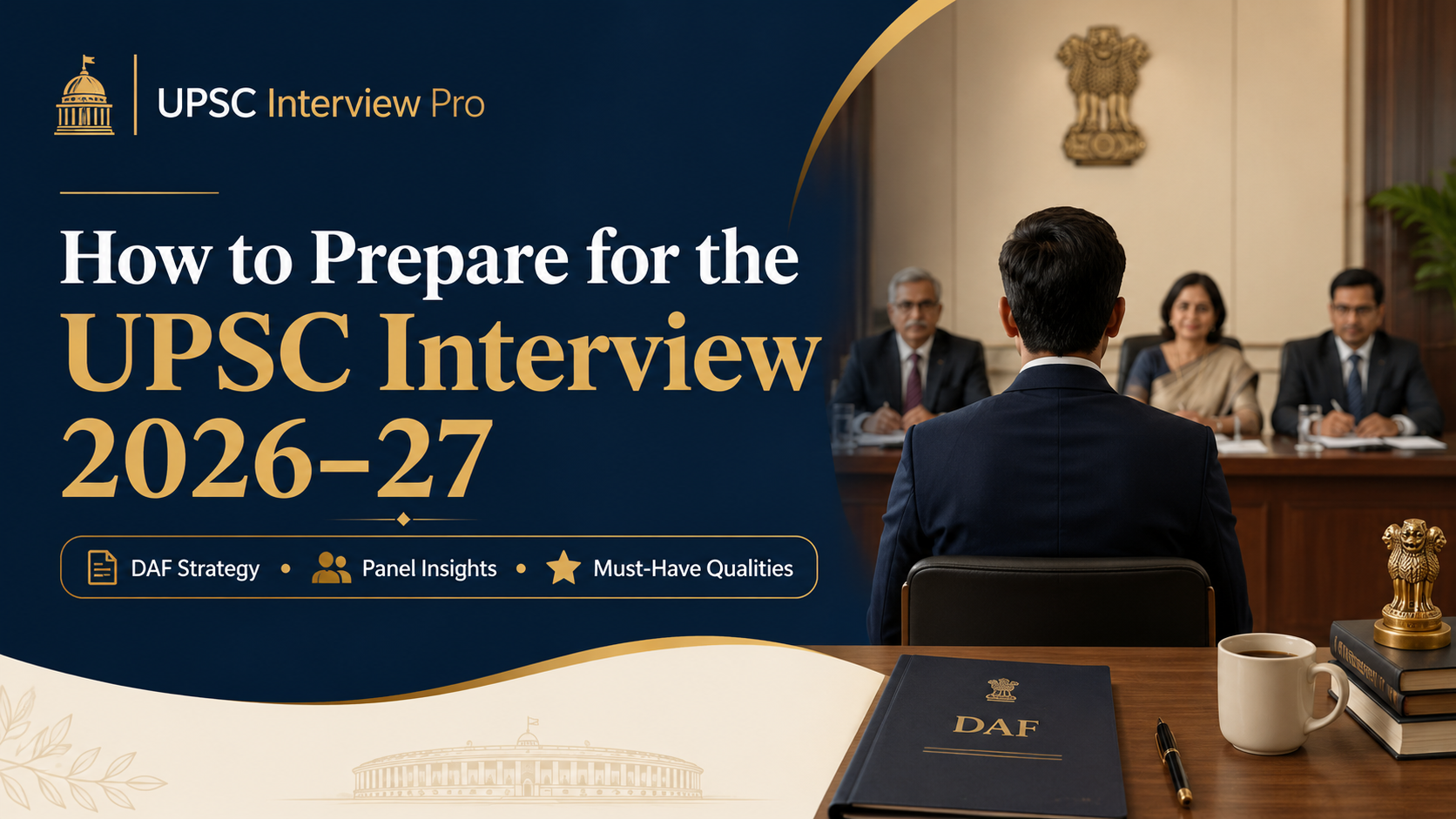
The UPSC Interview, officially known as the Personality Test, is the final stage of the Civil Services Examination. It carries 275 marks and plays an important role in the final merit list. By this stage, your written performance has already shown your knowledge, preparation, writing ability, and analytical understanding. The interview now gives the board an opportunity to understand your personality more closely.
This is why upsc interview preparation is different from Prelims and Mains preparation. Prelims check accuracy. Mains check depth, structure, and written expression. The interview checks your presence of mind, clarity, honesty, balance of judgment, communication, awareness, and overall suitability for public service.
Many candidates feel nervous before the interview because there is no fixed syllabus like Prelims or Mains. But the interview is not completely directionless. A large part of the discussion may come from your Detailed Application Form, your educational background, your home state, your district, your optional subject, your hobbies, your work experience, current affairs, and your views on important issues.
For UPSC Interview 2026–27, your DAF becomes one of the most important documents. The ias interview panel may ask questions from your name, hometown, district, state, education, optional subject, hobbies, achievements, work experience, service preference, and the reasons behind your choices. This is why understanding the role of daf in interview is very important.
A good preparation for upsc interview is not about memorising perfect answers. It is about knowing yourself better, understanding issues more deeply, and learning to express your thoughts in a calm and responsible way. The board does not expect you to know everything. It expects sincerity, awareness, balance, honesty, humility, and readiness to learn.
This guide will help you understand the shift from written exams to the interview stage, how to prepare your DAF, what the Personality Test evaluates, what qualities make you stand out, and how a good upsc interview guidance program can help you improve your final performance.
The Shift from Written to Spoken: What Lies Ahead?
After Mains, the nature of preparation changes. Until now, your effort was built around reading, revision, test series, answer writing, notes, and time management. In the interview, the focus shifts from written expression to spoken personality. You are not writing answers on paper. You are responding directly before a board.
This shift from written to spoken expression is important. In Mains, you get time to think, frame your answer, divide it into points, and present it in a structured way. In the interview room, you have to listen carefully, understand the question quickly, organise your thoughts, and answer with clarity. This is why upsc interview preparation must include speaking practice, not just reading.
The interview is not a test of memorised facts alone. Your knowledge has already been tested in Prelims and Mains. The board now observes whether you can use that knowledge with maturity. For example, if a question is asked about your district, the board may not expect only statistics. It may want to see whether you understand local issues, administrative challenges, people’s concerns, and practical solutions.
The ias interview panel may ask factual questions, opinion-based questions, situation-based questions, ethical questions, and questions from your DAF. Sometimes the question may look simple, but the board may be checking your clarity. Sometimes the question may be difficult, but the board may be checking your honesty and composure.
Many candidates make the mistake of trying to sound too impressive. They use heavy words, long sentences, and prepared lines. But the interview is not a speech competition. A simple, honest, and balanced answer is often more effective than a complicated answer.
One of the best upsc interview preparation tips is to speak naturally. Do not try to copy someone else’s style. Your answer should sound like your own thought, not like a memorised script. When you know something, answer confidently. When you do not know something, accept it politely. Honest acceptance is better than guesswork.
So, after Mains, your focus should shift from collecting more information to refining your personality. Read current affairs, but also form balanced opinions. Prepare your DAF, but also understand your own journey. Practise mock interviews, but do not become mechanical. The aim is to become more aware, more composed, and more genuine.
The DAF: Your Identity Document and Blueprint for Discussion
The Detailed Application Form, commonly known as DAF, is much more than a formality. It is your first introduction before the interview board. Even before you enter the room, your DAF tells the board who you are, where you come from, what you studied, what you like, what you have achieved, and what choices you have made.
This is why daf in interview plays such an important role. Many interview questions may come directly or indirectly from the DAF. If you prepare it well, it becomes your strength. If you ignore it, it can become a weak point.
Your DAF can generate questions from many areas. Your name may lead to questions about its meaning or any famous personality associated with it. Your hometown may lead to questions on geography, economy, culture, tourism, agriculture, industries, local administration, or current issues. Your graduation subject may lead to basic and application-based questions. Your optional subject may be connected with current affairs. Your hobbies may be checked to see whether they are genuine or just written for appearance.
A strong DAF strategy begins with honesty. Do not mention anything just because it sounds attractive. If you write reading as a hobby, you should know what you read, why you read it, and what you learned from it. If you mention cricket, music, painting, blogging, travelling, yoga, or social work, you should be able to speak about it comfortably. The ias interview panel can usually understand whether your interest is genuine or superficial.
For effective preparation for upsc interview, divide your DAF into different parts. Prepare your personal background, district, state, education, optional subject, work experience, hobbies, achievements, service preference, and cadre preference. Do not prepare only facts. Also prepare your own reflections.
For example, if your district is known for agriculture, do not stop at crop names. Understand irrigation, farmer income, market access, climate issues, government schemes, and local challenges. If you studied engineering, think about how technology can improve governance. If you studied commerce, connect it with taxation, banking, financial inclusion, and public finance.
The board may also ask “why” questions. Why did you choose this optional? Why do you want to join civil services? Why this service preference? Why did you leave your job? Why did you choose this hobby? Your answers should be clear, honest, and personal.
Among all upsc interview preparation tips, one of the most important is this: know every word written in your DAF. Do not take any detail lightly. Your DAF is your story on paper, and the interview is your chance to explain that story with confidence.
Read this – UPSC Interview Preparation: Complete Guide to Crack the Personality Test
The Personality Test: What It Truly Evaluates
The UPSC Interview is officially called the Personality Test. This name is important because the interview is not only about knowledge. It is about your personality as a whole.
Personality does not mean stylish speaking, fluent English, or artificial confidence. It means how you think, how you behave, how you communicate, how you handle pressure, how honest you are, and how suitable you appear for public service.
The board evaluates your thinking. Can you understand different sides of an issue? Can you give a balanced answer? Can you separate facts from opinions? Can you accept that some issues are complex? These qualities matter because civil servants work in real situations where decisions affect people, institutions, resources, and public trust.
The board also evaluates communication. A good answer should be clear, direct, respectful, and relevant. You do not need to give very long answers. You do not need to use difficult words. You need to answer the question in a calm and meaningful way.
Another important quality is emotional balance. The ias interview panel may ask counter-questions or may challenge your answer. This does not mean they are against you. It may simply be a way to understand whether you become nervous, defensive, irritated, or rigid. A good candidate listens patiently and answers respectfully.
Ethics also matters in the Personality Test. Your answers should reflect honesty, fairness, constitutional values, sensitivity toward weaker sections, and commitment to public welfare. But your answers should not be unrealistic. A good answer should combine values with practical thinking.
For example, if you are asked about corruption, do not only say that strict punishment is needed. A better answer may include transparency, digital processes, social audit, citizen charters, grievance redressal, protection for whistle-blowers, and accountability. This shows that you can think beyond slogans.
Good upsc interview preparation should therefore include three things: knowledge, reflection, and communication. You should know important issues, but you should also think about them deeply. You should practise speaking, but your answers should not sound memorised.
A good upsc interview guidance program can help you through DAF analysis, mock interviews, feedback, body language correction, and answer improvement. However, the final personality must remain yours. Guidance can polish you, but it should not make you artificial.
The board does not expect a perfect candidate. It looks for sincerity, awareness, balance, responsibility, and the ability to learn.
The Qualities That Make You Stand Out
The UPSC Interview is not about showing that you know everything. It is about showing that you are ready to learn, ready to serve, and ready to take responsibility. The board understands that candidates are still growing. What matters is the direction of your thinking and the maturity of your responses.
The first quality that makes you stand out is clarity. Your thoughts should be clear, and your words should reflect that clarity. If you are asked why you want to join civil services, your answer should not sound copied. It should come from your own understanding and experience.
The second quality is balance. Most governance issues are not black and white. Development is important, but the environment also matters. Technology improves service delivery, but privacy and digital exclusion must also be considered. Welfare schemes help people, but financial sustainability is also important. A balanced candidate understands these dimensions.
The third quality is honesty. If you do not know an answer, say it respectfully. If you realise you made a mistake, accept it. If your opinion has limitations, acknowledge them. Honesty creates trust, and trust is very important in public service.
The fourth quality is empathy. A civil servant works with people from different backgrounds. Your answers should show sensitivity toward women, children, farmers, workers, elderly people, persons with disabilities, tribal communities, and marginalised groups. Empathy does not mean emotional weakness. It means understanding people’s problems before suggesting solutions.
The fifth quality is administrative sense. Your answers should not remain only theoretical. You should think about implementation, institutions, resources, accountability, and outcomes. For example, instead of only saying that awareness should be created, explain who will create awareness, how it will be monitored, and how impact will be measured.
The sixth quality is humility. A humble candidate listens carefully, accepts feedback, and does not try to dominate the conversation. Humility does not mean lack of confidence. It means confidence without arrogance.
These qualities cannot be developed in one day. They develop through reading, reflection, discussion, feedback, and practice. That is why upsc interview preparation should begin early and continue with discipline.
One of the most useful upsc interview preparation tips is to record your answers and listen to them. You will understand whether you are speaking too fast, giving long answers, repeating words, or missing the main point. Small improvements can make a big difference.
The board is more likely to remember candidates who are natural, thoughtful, respectful, and balanced. You do not need to act like an officer. You need to show that you have the potential to become one.
The Final Note- It is Your Story-Tell It with Grace
At the end, the UPSC Interview is your story. It is not only about your marks, optional subject, degree, or current affairs knowledge. It is about the person shaped by all these experiences.
Every candidate has a different journey. Some come from big cities. Some come from small towns or villages. Some have strong academic records. Some have average marks but strong determination. Some have work experience. Some are fresh graduates. Some clear stages early. Some face repeated failures before reaching the interview. None of these journeys is automatically better or worse. What matters is how honestly you understand your own journey.
This is why preparation for upsc interview should begin with self-reflection. Ask yourself: Why do I want to join civil services? What have I learned from my failures? What are my strengths? What are my weak areas? What values matter to me? What kind of officer do I want to become?
These questions are not for memorising answers. They are for building inner clarity. When your inner clarity is strong, your answers become natural.
Your DAF should support your story. Your education, hobbies, district, family background, work experience, and service preference should not look disconnected. You should be able to explain them simply and confidently. The ias interview panel may not ask every question from your DAF, but preparing it properly will make you more self-aware.
Do not enter the interview room with fear. Also, do not enter with arrogance. Enter with calm confidence. Speak respectfully. Listen fully. Accept what you do not know. Give balanced views. Avoid extreme statements. Do not argue unnecessarily. Do not try to impress through memorised language.
A good upsc interview guidance program can help you polish your preparation, but the board finally meets you, not your coaching notes. Your answers must sound real. Your confidence must feel natural. Your personality must reflect sincerity.
Tell your story with grace. Not with fear. Not with overconfidence. Not with rehearsed drama. Tell it as a responsible aspirant who understands that civil services are not only about power and position, but about duty, fairness, patience, and service.
Read this – Who Takes Interview in UPSC 2026, Board, Panel Members, Process,
DAF Checklist for UPSC Interview 2026–27
Use this checklist to prepare your DAF properly.
- Name and Background
Know the meaning of your name and any historical, cultural, or famous personality connection. - Hometown and District
Prepare geography, economy, culture, local administration, famous places, industries, social issues, and recent news. - State Profile
Study your state’s economy, major schemes, development challenges, social indicators, environment, and current affairs. - Graduation Subject
Revise basic concepts and think about how your subject connects with governance and public policy. - Optional Subject
Prepare important concepts, current relevance, and possible interview questions from your optional. - Hobbies and Interests
Prepare genuine answers. Do not mention hobbies only to impress the board. - Work Experience
Prepare your role, responsibilities, learning, challenges, and reason for moving toward civil services. - Service Preference
Be clear about why you have chosen IAS, IPS, IFS, IRS, or other services in that order. - Cadre Preference
Prepare logical reasons related to region, language, exposure, or administrative interest. - Achievements and Activities
Be ready to explain what you did, what you learned, and how it shaped your personality.
IAS Interview Panel Insights: What the Board Usually Observes
The ias interview panel generally observes three things: what you know, how you think, and how you behave.
First, the board observes your content. This includes your knowledge, facts, examples, current affairs awareness, and understanding of issues.
Second, it observes your thinking process. This includes logic, balance, openness, ethical clarity, and practical judgment.
Third, it observes your behaviour. This includes confidence, humility, listening ability, body language, tone, patience, and emotional control.
A candidate who knows many facts but lacks balance may not create a strong impression. Similarly, a candidate who speaks well but lacks depth may also struggle. The ideal candidate combines awareness with maturity.
The board may also check whether your answers are original or memorised. If every answer sounds like a coaching template, the conversation becomes weak. Use guidance, but personalise your answers.
Practical Answer Examples for UPSC Interview
Question 1: Why do you want to join civil services?
Weak answer:
I want to serve society and contribute to nation-building.
Better answer:
Civil services attract me because they provide an opportunity to work directly on public problems at the field level as well as at the policy level. During my preparation, I realised that issues like education, health, livelihood, and local governance require not only good policies but also sensitive implementation. I want to be part of that implementation process with responsibility and integrity.
Question 2: What if you do not get your preferred service?
Weak answer:
I will try again because IAS is my only dream.
Better answer:
My first preference reflects my interest, but every civil service provides a meaningful opportunity to contribute to the country. If I get another service, I will accept it with responsibility and try to perform with sincerity. Public service is larger than one designation.
Question 3: What is your biggest weakness?
Weak answer:
I am a perfectionist.
Better answer:
Earlier, I used to spend too much time refining small tasks, which sometimes affected speed. During preparation, I worked on this by setting time limits, prioritising tasks, and accepting that timely completion is also important. I am still improving, but I have become more disciplined in balancing quality with time.
Question 4: What will you do if your senior gives you an unethical order?
Weak answer:
I will directly refuse.
Better answer:
First, I will understand the instruction clearly and verify whether it violates rules, law, or public interest. If it is unethical or illegal, I will respectfully place my concern before the senior and suggest a lawful alternative. If pressure continues, I will follow the proper official procedure and record my position as per rules.
Common Mistakes to Avoid in UPSC Interview Preparation
- Memorising ready-made answers without understanding them.
- Ignoring DAF and focusing only on current affairs.
- Writing fake hobbies or exaggerated achievements.
- Giving extreme opinions on sensitive issues.
- Speaking too much without directly answering the question.
- Bluffing when you do not know the answer.
- Becoming defensive during counter-questions.
- Using too much technical jargon or bookish language.
- Ignoring state, district, and background-based preparation.
- Treating mock interviews as performance instead of feedback.
FAQ on UPSC Interview Preparation 2026–27
1. How should I start upsc interview preparation after Mains?
Start with your DAF. Prepare your personal background, district, state, education, optional subject, hobbies, work experience, and service preference. Along with this, continue reading current affairs with analysis.
2. Why is daf in interview so important?
The DAF is important because it gives the board a clear map of your personality, background, choices, and interests. Many interview questions may be framed from the DAF.
3. What does the ias interview panel actually check?
The panel checks your suitability for public service. It observes your knowledge, balance, honesty, clarity, emotional stability, ethical judgment, and communication.
4. What are the best upsc interview preparation tips?
The best tips are: know your DAF deeply, read current affairs analytically, practise speaking, stay honest, avoid extreme views, give concise answers, and remain calm during counter-questions.
5. Is English fluency necessary for UPSC Interview?
No. Clear communication matters more than decorative English. Candidates should use the permitted medium of communication clearly and confidently. The board values clarity, confidence, content, and balanced expression.
6. Should I join an upsc interview guidance program?
A good guidance program can help through mock interviews, DAF analysis, feedback, and confidence building. However, it should refine your natural personality, not make you artificial.
7. How much time is needed for preparation for upsc interview?
The ideal preparation begins immediately after Mains. Serious DAF-based preparation should start as soon as the interview stage becomes likely.
Why Choose UPSC Interview Pro for UPSC Interview Guidance?
The UPSC Interview is not only about answering questions. It is about presenting your complete personality with clarity, confidence, and maturity. UPSC Interview Pro is designed to support aspirants in preparing for this final stage in a focused and practical way.
UPSC Interview Pro provides guidance from toppers and experts to help aspirants approach the interview with better clarity and confidence. The platform focuses on DAF-based preparation, mock interview practice, expert feedback, communication improvement, current affairs discussion, and personality refinement.
A strong upsc interview guidance program should help you understand your DAF, improve your answers, identify weak areas, and build confidence before the actual board. UPSC Interview Pro follows an interview-oriented approach where the goal is not to create rehearsed candidates, but to help aspirants present their real personality in a sharper and more mature way.
If you are preparing for the UPSC Interview 2026–27, do not leave your final stage to guesswork. Prepare your DAF, understand the board, practise speaking, refine your answers, and enter the interview room with calm confidence.
Your journey deserves a strong final presentation. UPSC Interview Pro can help you prepare for it with clarity, discipline, and guidance.


