

 Offline/Online Class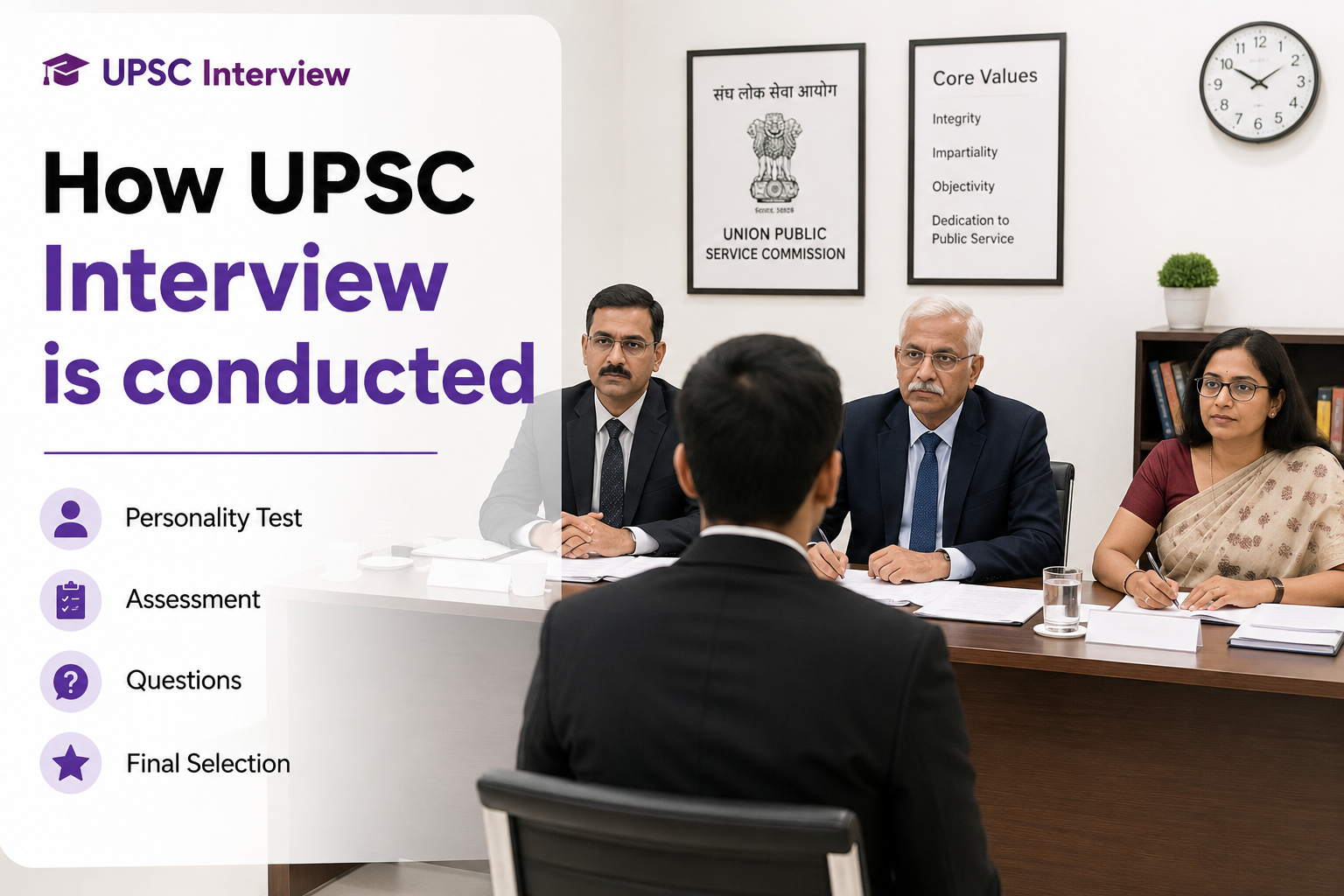
The UPSC interview, officially called the Personality Test, is the final stage of the Civil Services Examination. It is held after a candidate clears the written Main Examination. The interview carries 275 marks.
Its purpose is to assess whether a candidate has the judgement, honesty, awareness, communication skills and balanced personality needed for public service.
Before the UPSC Interview
After the Main Examination result, selected candidates complete online formalities and receive an e-Summon Letter. They verify their details and submit the required documents.
The interview board studies the candidate’s application profile. Questions may come from the candidate’s hometown, graduation subject, optional subject, work experience, hobbies, achievements and service preferences.
Candidates should review every detail because each entry can lead to questions.
Interview Day
Candidates report at the venue mentioned in the e-Summon Letter. Identity and document verification are completed before the interview. After security checks, they wait for their turn before entering the interview room.
The board usually includes a chairperson and other members. The conversation commonly lasts around 20 to 30 minutes, although the duration may vary.
How Does the Interview Begin?
The chairperson generally starts with simple questions about the candidate’s background, education, job or civil-service motivation.
The candidate should answer naturally. Clear, short and honest responses create a better impression than long answers.
Types of Questions Are Asked
There is no fixed question paper for the UPSC interview. The discussion changes according to the candidate’s profile and responses.
Personal questions may cover background, hometown, interests and experiences.
Academic questions may come from the graduation subject or optional subject. The board may ask how that subject can help in administration or public policy.
Working candidates may be asked about their job, skills and reason for choosing civil services.
Current-affairs questions test whether the candidate understands important national and international issues. The board may ask about causes, effects, challenges and possible solutions.
Opinion-based questions examine whether the candidate can present a balanced view supported by logic.
Situation-based questions place the candidate in the role of an administrator. The board may ask how the candidate would handle a protest, disaster, corruption complaint or conflict between development and environmental protection.
Ethical questions may involve pressure, improper orders, corruption or conflicts of duty.
The board looks for alertness, clear expression, logical thinking, balanced judgement, leadership, honesty and integrity.
It also observes how the candidate listens, responds under pressure and handles disagreement. The board does not expect the candidate to know every answer.
When a candidate does not know a fact, it is better to admit it politely than to guess. A polite admission shows honesty.
How Should Questions Be Answered?
A good answer should directly address the question and answer the main point clearly. Candidates should avoid unnecessary background and lengthy explanations.
For analytical questions, explain the issue, present the main sides, mention the key challenge and suggest a practical way forward.
Candidates may disagree with a board member, but the disagreement should remain polite and well-reasoned.
Prepare for the UPSC Interview
Effective UPSC interview preparation should begin with a careful review of the candidate’s profile.
Candidates should prepare questions from their hometown, education, optional subject, work experience, hobbies and service preferences. They should also develop balanced views on current issues.
Speaking practice is important because the interview tests the ability to think and answer at the same time. Candidates should practise clear answers and record themselves to improve pace and structure.
Also Read This –
UPSC Interview Preparation: DAF, Mock Interview and Success Strategy
Role of a UPSC Mock Interview
A UPSC mock interview helps candidates experience a formal board setting before the real interview. It can identify weak areas in answers, listening, body language and pressure handling.
Mock interviews should be used for improvement, not for memorizing fixed replies. Too many mocks may create confusion because different panels give different suggestions.
Candidates should avoid bluffing, interrupting the board, giving memorized answers, speaking for too long, taking extreme positions and giving false details about hobbies or achievements.
They should not treat the interview as a debate. The aim is to show calm judgement, honesty and maturity.
Candidates should wear simple formal clothes, maintain natural eye contact and listen carefully. The final merit list is prepared by adding interview marks to the written Main Examination marks for final ranking.
Also Read This –
Is It Compulsory to Wear a Saree in the UPSC Interview?
The UPSC interview is conducted as a guided conversation to assess the candidate’s suitability for public service. Questions are based on the candidate’s background, education, work, interests, current affairs and administrative situations.
Strong UPSC interview preparation requires profile-based study, balanced thinking and speaking practice. A well-planned UPSC mock interview can help correct weaknesses, but the candidate should remain natural, honest and composed during the real Personality Test.


