

 Offline/Online Class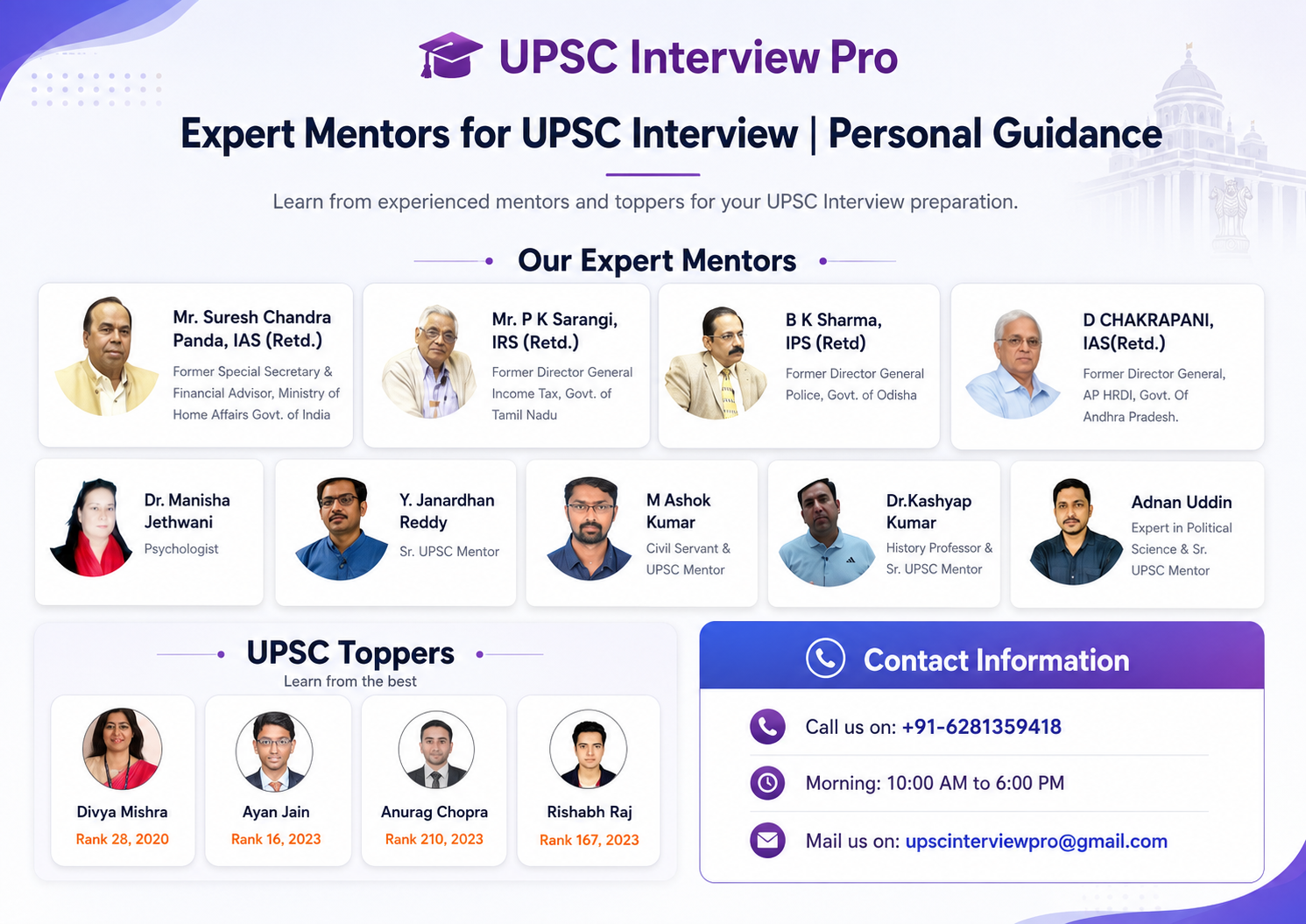
Clearing the UPSC Civil Services Main Examination brings an aspirant to the final and highly significant stage of the selection process—the UPSC Interview or Personality Test. At this stage, knowledge remains important,
The UPSC Interview carries 275 marks, with no separate minimum qualifying marks. These marks are added to the written Mains score to determine the candidate’s final rank and service allocation. UPSC describes the Personality Test as an assessment of qualities such as mental alertness, logical expression, balanced judgement, leadership, social awareness, intellectual integrity and moral integrity.
guidance from experienced administrators, subject specialists, a psychologist and senior UPSC mentors can help bring greater structure and direction to preparation. UPSC Interview Pro connects aspirants with a multidisciplinary panel for DAF-focused preparation, current-affairs understanding, communication development and personality-test guidance.
Expert Mentors Matter in the UPSC Interview
UPSC defines it as a natural but directed conversation intended to reveal a candidate’s mental qualities and suitability for a career in public service.
This makes interview preparation different from preparation for Prelims and Mains. Candidates may know an issue well but still struggle to:
- answer the exact question asked by the board;
- present a balanced position on a sensitive subject;
- organise their response in a logical sequence;
- connect personal experiences with public-service values;
- remain composed during unexpected follow-up questions;
- acknowledge a lack of knowledge without becoming nervous;
- suggest solutions that are lawful, practical and citizen-centric.
Experienced Mentors for UPSC Interview preparation can identify these gaps and guide candidates toward clearer, more mature and more natural responses. The purpose of mentorship is not to create artificial answers. It is to help an aspirant express genuine opinion with greater clarity, balance and administrative understanding.
Meet the Expert Mentors at UPSC Interview Pro
The UPSC Interview Pro panel includes retired IAS, IPS and IRS officers, a psychologist, senior UPSC mentors and academic experts. Their professional backgrounds cover public administration, policing, taxation, psychology, history, political science and interview preparation. The names and designations below are listed on the platform’s official team and DAF-registration pages.
- Mr. Suresh Chandra Panda, IAS (Retd.) — Former Special Secretary and Financial Advisor, Ministry of Home Affairs, Government of India.
- Mr. P. K. Sarangi, IRS (Retd.) — Former Director General of Income Tax, Government of Tamil Nadu.
- B. K. Sharma, IPS (Retd.) — Former Director General of Police, Government of Odisha.
- D. Chakrapani, IAS (Retd.) — Former Director General, AP HRDI, Government of Andhra Pradesh.
- Dr. Manisha Jethwani — Psychologist.
- Y. Janardhan Reddy — Senior UPSC Mentor.
- M. Ashok Kumar — Civil Servant and UPSC Mentor.
- Dr. Kashyap Kumar — History Professor and Senior UPSC Mentor.
- Adnan Uddin — Political Science Expert and Senior UPSC Mentor.
Personal Guidance Based on the Detailed Application Form
The Detailed Application Form, commonly called the DAF, is one of the most important foundations of UPSC Interview preparation. The interview board has access to the candidate’s career record, and questions can arise from the information provided by the candidate.
A structured DAF review should cover the following areas.
Personal Background
Candidates should prepare the meaning or significance of their name, place of birth, family background and major personal experiences. Answers should remain authentic and should not sound like memorised introductions.
Home State and District
Preparation should include the geography, economy, culture, administration, developmental challenges and recent developments associated with the candidate’s state and district.
Educational Background
Questions may arise from graduation subjects, university, academic choices and the relevance of the candidate’s education to administration.
Candidates changing from engineering, medicine, law, commerce or another professional field to civil services should be ready to explain the transition positively and logically.
Work Experience
Working professionals may be asked about their responsibilities, organisational challenges, ethical situations, teamwork and the lessons they can transfer to public administration.
Optional Subject
Candidates should revise essential concepts from their optional subject and understand its connection with current national or international developments.
Hobbies and Interests
Every hobby mentioned in the DAF should be genuine. Candidates should prepare its fundamentals, important personalities, recent developments and personal relevance.
UPSC Interview Pro’s registration system allows aspirants to upload their DAF in PDF format along with their contact and state details.
Aspirant Mentorship Improves Interview Preparation
Effective aspirant mentorship is diagnostic rather than generic. Every candidate has a different DAF, personality, communication style and preparation gap.
Clear Answer Structure
A useful response normally begins with a direct answer, followed by brief reasoning and a balanced conclusion. Candidates should avoid giving a long background before addressing the actual question.
Balanced Judgement
Questions on politics, religion, social conflict, federalism, national security or foreign policy require sensitivity. Mentors can help candidates understand multiple viewpoints without becoming vague or indecisive.
Administrative Orientation
An interview answer should not remain purely theoretical. Candidates should learn to consider legality, implementation capacity, financial resources, stakeholder interests and possible unintended consequences.
Ethical Reasoning
Situational questions often test integrity, empathy, accountability and courage of conviction. A candidate should be able to distinguish between personal morality, legal responsibility and institutional procedure.
Communication and Composure
Effective communication does not require complicated English. It requires clarity, relevance, appropriate tone and attentive listening.
Honest Handling of Unknown Answers
No candidate is expected to know everything. A calm and honest acknowledgement is usually more appropriate than bluffing, guessing recklessly or presenting doubtful information as fact.
Current Affairs Preparation for the UPSC Interview
Current affairs are directly relevant to the Personality Test. UPSC expects candidates to show intelligent interest in developments occurring within their state, India and the wider world.
Interview preparation should therefore move beyond memorising headlines. Candidates should develop a structured understanding of important issues by examining:
- the background of the issue;
- constitutional and legal dimensions;
- major stakeholders;
- competing viewpoints;
- social and economic consequences;
- implementation challenges;
- India’s national interest;
- practical and balanced solutions.
UPSC Interview Pro maintains a current-affairs section covering recent developments relevant to UPSC preparation. It also publishes interview-focused resources on personal questions, current affairs, ethical situations and administrative challenges.
UPSC Toppers
UPSC Interview Pro features the following UPSC candidates on its website:
- Divya Mishra — Rank 28, CSE 2020
- Ayan Jain — Rank 16, CSE 2023
- Anurag Chopra — Rank 210, CSE 2023
- Rishabh Raj — Rank 167, CSE 2023
- Bidipto Sarkar — Rank 987, CSE 2023
Toppers’ experiences can help aspirants understand the importance of consistency, DAF preparation, current-affairs awareness, mock interaction and honest communication..
UPSC Interview Pro
UPSC Interview Pro offers a focused for candidates preparing for the final stage of the Civil Services Examination. Its multidisciplinary panel combines experience from administration, policing, taxation, psychology, history, political science and UPSC mentoring.
This approach can help candidates:
- examine every significant part of their DAF;
- improve the relevance and structure of their answers;
- develop balanced views on current issues;
- understand the administrative dimensions of problems;
- communicate with greater clarity and composure;
- identify avoidable weaknesses before the actual interview;
- present their genuine personality without sounding rehearsed.
Contact UPSC Interview Pro
Candidates can submit their details and upload their DAF through the UPSC Interview Pro admission form.
Phone: +91 6281359418
Consultation Hours: 10:00 AM to 6:00 PM
Email: upscinterviewpro@gmail.com
Guidance from experienced Expert Mentors for UPSC Interview preparation can help aspirants connect their DAF, current affairs, academic background and personal experiences with the qualities evaluated by the UPSC board.


